Pet-care OEM insights
Pet Ear Care: A Safety-First Guide for Brand Owners
Learn a safety-first pet ear-care routine, key veterinarian warning signs, and how responsible cleaning formulas support comfortable, healthy pets at home.
Responsible pet ear care begins with a clear boundary: routine maintenance can support comfort and cleanliness, but it does not diagnose an ear condition, replace a veterinary exam, or guarantee that infection will not occur. For brands building an ear-care range, that distinction should shape the formula brief, product directions, and every customer-facing claim.
What routine ear care is — and is not
A thoughtful routine starts with observation, not an automatic cleaning schedule. Some dogs may benefit from maintenance cleaning when their veterinarian recommends it, particularly after water exposure or when there is visible, minor debris. Other pets with clean, comfortable ears may need little or no routine cleaning. Over-cleaning can irritate the ear canal, so frequency should be individual rather than promotional.[1][2]
Ear disease can have many underlying causes, including allergies, parasites, anatomy, or other conditions. A consumer product should never be positioned as a substitute for determining the cause of pain, discharge, odor, or persistent irritation.
Begin with a simple visual check
Before recommending any at-home step, teach customers to notice the pet’s comfort and the visible outer ear. The table below is a practical escalation framework for educational content and customer-support materials.
Observe
Ears appear comfortable, with no unusual odor, discharge, redness, or sensitivity.
Next step: Do not clean simply because a calendar says to. Continue normal observation and follow the pet’s veterinarian-led routine.
Observe
Minor visible debris after a swim or bath, with the pet otherwise comfortable.
Next step: Use only a pet-specific cleaner and a method previously approved for that pet; keep the action gentle and external.
Stop and call a veterinarian
Redness, itching, discomfort on touch, repeated head shaking, increased wax, discharge, or a persistent odor.
Next step: Pause home cleaning and contact a veterinarian for guidance. These signs may have more than one cause.
Seek prompt veterinary advice
A head tilt, loss of balance, severe pain, bleeding, or sudden behavior change.
Next step: Seek veterinary advice promptly rather than attempting to clean or treat the ear at home.
A gentle method for pets cleared for at-home cleaning
When a veterinarian has confirmed that an at-home maintenance routine is appropriate, the method should be calm, simple, and designed to avoid pushing material deeper into the canal. Cornell and VCA both emphasize gentle handling, cotton pads or gauze rather than cotton-tipped swabs, and stopping if the pet appears painful.[1][2]
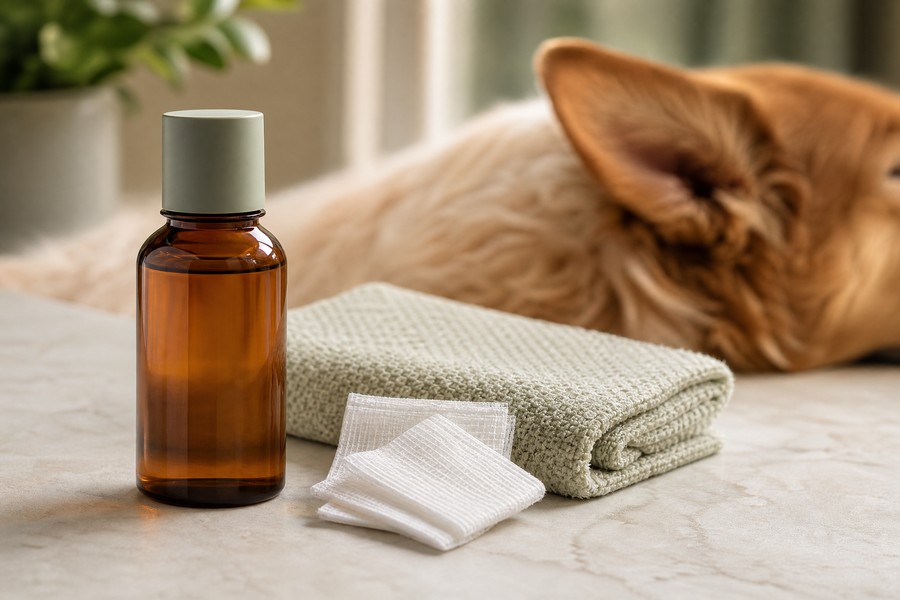
- Prepare the right supplies. Use a veterinarian-recommended pet ear cleaner, clean gauze or cotton pads, a towel, and rewards. Do not substitute human ear drops or make a home formula.
- Keep the pet comfortable. Choose a calm setting. Lift the ear flap only enough to see the outer opening; do not force the pet to continue.
- Follow the product and veterinary directions exactly. Do not place the bottle tip inside the ear or create forceful pressure. If the tip touches the ear, clean it before reuse.
- Massage gently at the base of the ear. A brief, gentle massage can help loosen material when this method is appropriate for the pet.
- Let the pet shake, then wipe only what is easy to reach. Use gauze or a pad around the visible outer area. Never insert cotton-tipped swabs into the canal, and do not probe beyond what a finger can comfortably reach.
- Stop if there is pain or resistance. Do not try to “finish the clean.” Contact a veterinarian for advice instead.
Formula and claim standards for responsible brands
For a private-label or contract-manufactured ear-care product, the first brief should be about appropriate use, comfort, traceable specifications, and clear instructions—not an oversized promise. A responsible formula review considers the intended use, compatibility with the target pet population, packaging hygiene, ingredient transparency, and directions that clearly state when veterinary care takes priority.
- Define the use case precisely. A maintenance cleaner and a treatment product are not interchangeable. Avoid wording that claims to cure infections, remove mites, or replace medicated therapy.
- Keep the instructions conservative. Include an external-use direction, a “do not use if the pet is painful or the ear is inflamed” warning, and a prompt to seek veterinary guidance for abnormal signs.
- Design for hygienic handling. Explain how to avoid contaminating the applicator and how to store the product as directed.
- Substantiate every claim. “Gentle,” “deodorizing,” “wax-removing,” “antimicrobial,” or “for sensitive ears” each require a formulation, testing, and regulatory rationale appropriate to the market.
For brand teams developing a broader grooming range, the relevant commercial decision is not simply whether to add an ear product. It is whether the product brief, label language, and customer-support plan work together responsibly. Talk with PawLab Pro about a clear, product-specific development brief, or review the current Bath & Grooming collection for adjacent care categories.
Four mistakes an ear-care guide should prevent
- Using cotton swabs inside the ear canal. Swabs can push debris inward and may injure sensitive structures. Use gauze or a cotton pad only where it is safely reachable.
- Treating odor or discharge as a DIY problem. A persistent change can indicate a condition that needs veterinary assessment rather than a stronger cleanser.
- Cleaning on a fixed schedule regardless of the pet. Individual needs differ, and over-cleaning can cause irritation.
- Using human or improvised products. A pet-specific formula and a veterinarian’s recommendation are safer than a household substitute, especially for a sensitive or inflamed ear.
Questions customers commonly ask
How often should a pet’s ears be cleaned?
There is no single universal interval. For a healthy pet, cleaning may only be appropriate when debris is visible or after the ears get wet; pets with allergies or recurrent ear problems may need a different veterinarian-led plan.[1]
Can a cleaning solution treat an ear infection?
No consumer guide should make that promise. Cleaning can be one part of a veterinary treatment plan, but an infection requires professional assessment and may need medication selected for the underlying cause.
Can the same directions be used for cats and dogs?
Do not assume that a dog product or routine suits a cat. Product selection and frequency should be confirmed with the animal’s veterinarian, especially when there is discomfort, discharge, or a history of ear disease.
Build trust with clear escalation, not bigger promises
Pet carers do not need an ear-care product to promise certainty. They need a useful, low-stress routine, directions they can follow, and clear signals for when to stop and consult a veterinarian. For a brand, that safety-first approach protects the customer experience while creating a more credible basis for product development and long-term trust.