Pet-care OEM insights
Powder Dry Shampoo vs Pump Foam Cleanser: Absorption, Coat Distribution, Residue and Packaging Tests for Pet Brands
Compare powder dry shampoo and pump foam cleanser for pet brands through absorption, distribution, residue, repeat-use, packaging and cost-per-use tests.
For a private-label pet-care launch, powder dry shampoo and pump foam cleanser should not be approved with the same test sheet. Powder depends on controlled release, surface absorption, visible residue and brush-out. Pump foam depends on delivered liquid mass, foam density, wetting, dry-down and repeated-use feel. Packaging changes both results, so the comparison must be run on the finished powder-or-formula and its intended component.
This article is for OEM/ODM, private-label, distributor, retail and professional-grooming buyers deciding which format deserves a sample round. It does not promise a universal cleaning result, all-coat suitability, a fixed dose, a shelf life, a safety outcome or a regulatory classification. It turns the most decision-relevant observations into a practical comparison brief.
TAKEAWAYS
- Compare systems, not ingredient stories. The powder or liquid, dispenser, closure, instructions and test surface must be treated as one finished sample.
- Powder wins or loses at release and removal. Single-dispense mass, local distribution, dark-coat visibility and brush-out are more useful than a generic “light” or “fresh” description.
- Foam wins or loses at repeatable delivery. Pump output, foam density, coverage, dry-down time and accumulation after repeat use should be recorded together.
- Moisture is a format-specific risk. Powder may cake or flow unevenly; a foamer may lose output or clog when viscosity, mesh or formula compatibility changes.
- Cost should be calculated per approved use. Compare the mass or pump strokes needed for the same defined coat area, then add filled-pack weight, shipping and component cost.
1. What Is the Real Difference Between Powder and Pump Foam?
The useful distinction is not simply “dry versus wet.” Powder is a particulate system that must be released, spread across a defined surface and removed or left according to the approved use instruction. Pump foam is a liquid-and-air delivery system that must create a repeatable volume and bubble structure before it is distributed through the coat.
That difference changes the buyer’s approval questions. A powder sample can look fine in a jar but fail through an aperture. A foam can look attractive in the hand but deliver too little liquid per stroke or dry with a heavy feel. The comparison below should be read as a development map, not as a universal ranking.
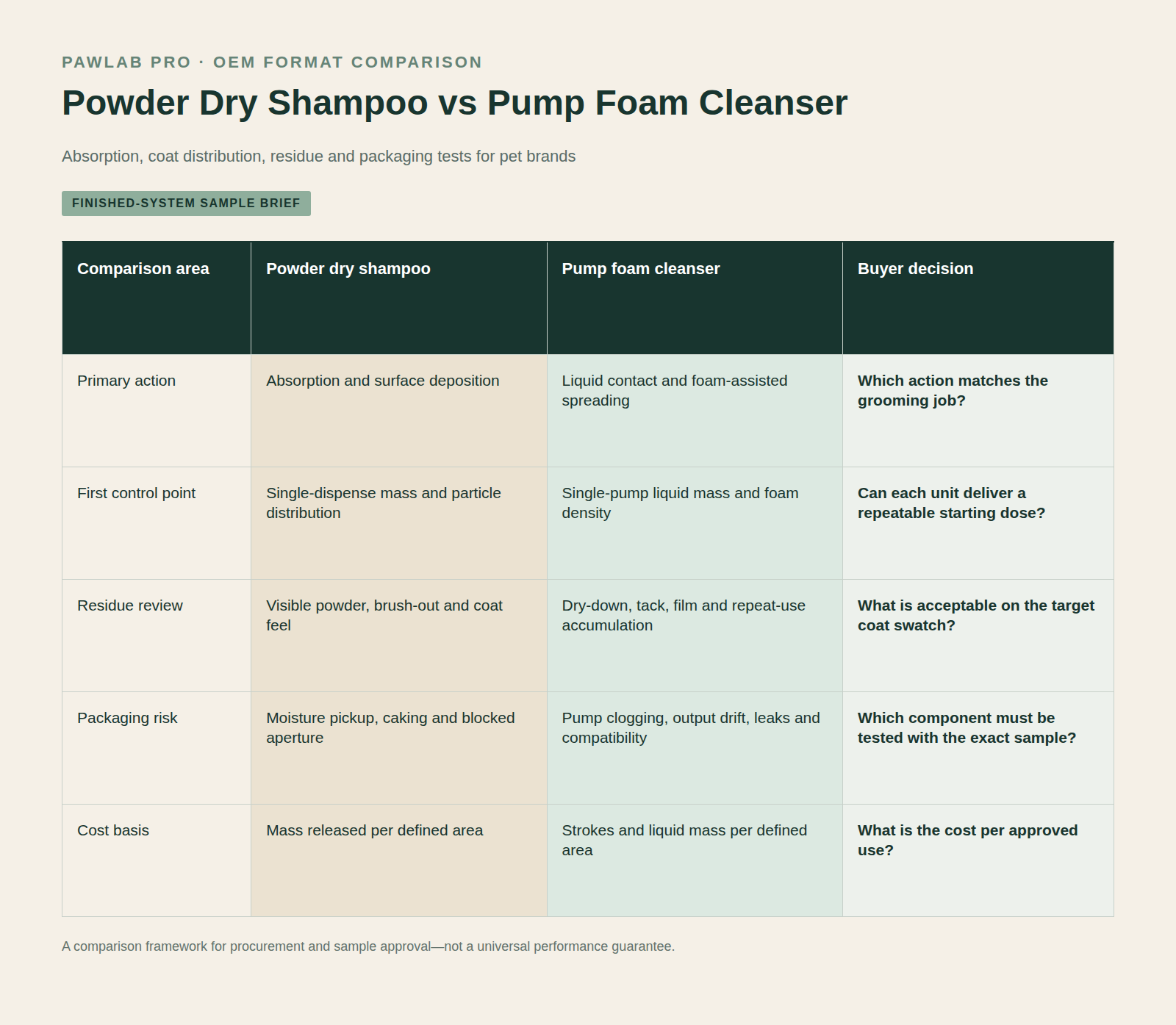
| Comparison area | Powder dry shampoo | Pump foam cleanser | Buyer decision |
|---|---|---|---|
| Primary action | Absorption and surface deposition | Liquid contact and foam-assisted spreading | Which action matches the intended grooming job? |
| First control point | Single-dispense mass and particle distribution | Single-pump liquid mass and foam density | Can each unit deliver a repeatable starting dose? |
| Residue review | Visible powder, brush-out and coat feel | Dry-down, tack, film and repeat-use accumulation | What is acceptable on the target coat swatch? |
| Packaging risk | Moisture pickup, caking and blocked aperture | Pump clogging, output drift, leaks and closure compatibility | Which component must be tested with the exact sample? |
| Cost basis | Mass released per defined area | Strokes and liquid mass per defined area | What is the cost per approved use, not just per bottle? |
2. How Should Brands Test Powder Absorption, Release and Distribution?
A powder dry shampoo OEM brief should begin with a controlled release test. Weigh the component before and after a defined number of shakes, squeezes or applications. Record the average mass per event and the spread between the first, middle and final events. The point is not to prescribe a universal dosage. It is to learn whether the chosen pack gives a repeatable starting condition.
| Powder test | Suggested observation | Why it matters |
|---|---|---|
| Single-dispense mass | Mass released from the same pack after one defined actuation or handling sequence | Shows whether “one application” means the same thing across samples |
| Particle distribution | Spread on a dark and light test surface or controlled coat swatch | Reveals local piles, gaps, plume behavior and uneven deposition |
| Absorption contact | Observe the same powder amount after the defined contact window | Separates a visual powder deposit from an actual surface-oil observation |
| Brush-out removal | Collect or visually score powder removed after the specified brushing action | Creates a removal record instead of assuming “easy brush-out” |
| Dark-coat visibility | Photograph the same area before application and after brush-out | White or pale residue can be more visible on dark coats than on pale swatches |
For private label pet dry shampoo projects, the test surface should be named in the record. A short, smooth swatch can hide a distribution problem that appears on a long or dense coat. The brand should therefore compare at least the coat conditions it intends to show in its instructions or marketing, without turning a small sample observation into an all-breed performance promise.
3. What Should Brands Measure for Pump Foam Coverage and Dry-Down?
A pump foam sample needs a different starting point: the mass and physical presentation of one pump. Measure the bottle before and after a defined number of strokes, then record the average liquid mass per stroke. Separately, capture foam height or volume immediately after dispensing and after a short, fixed interval. Foam volume alone is not enough; a large bubble structure may collapse before the product can be distributed.
| Foam test | Suggested observation | Commercial implication |
|---|---|---|
| Single-pump liquid mass | Filled-pack mass change over repeated strokes | Supports a realistic per-use cost and coverage discussion |
| Foam density | Capture foam mass and occupied volume using the same vessel and timing | Shows whether the pump produces the intended texture consistently |
| Coverage per defined area | Record strokes needed for the same coat-swatch area | Prevents a larger bottle from looking cheaper when it needs more product |
| Drying time | Record time to the agreed dry-touch or comb-through observation | Links formula feel to the intended grooming workflow |
| Repeat-use accumulation | Repeat the same application over several sessions and score tack, weight or film | Identifies build-up risk that one application cannot reveal |
A pump foam pet cleanser manufacturer should test the formula with the intended foamer, not a convenient substitute. A packaging supplier notes that viscosity, bottle material, neck finish and the complete pump-bottle system affect foamer performance, and recommends testing the formula and component together [1]. That is a packaging-development principle, not a guarantee for any particular pet formula.
4. How Do Residue and Coat Distribution Change the Choice?
Residue is not one measurement. Powder residue is usually a visibility and removal question. Foam residue is usually an after-feel and accumulation question. Both require a defined observation window, a named coat condition and a consistent grooming action.
| Residue question | Powder route | Pump foam route |
|---|---|---|
| Immediately after application | Where did the particles settle, and is the distribution local or patchy? | How much foam remains on the surface, and does it spread before collapsing? |
| After the defined action | How much visible material remains after brushing or removal? | How does the coat feel after towel-off or dry-down? |
| On a dark coat | Score pale specks, streaks or deposits under consistent lighting | Score wet-looking patches, film or clumping after drying |
| After repeat use | Check whether powder settles into the same regions or becomes difficult to remove | Check tack, weight, dullness or combing change over repeated applications |
Do not publish “zero residue” from a single visual check. A more defensible brief uses an acceptance phrase such as “no visible deposit beyond the agreed review threshold on the selected dark swatch after the defined brush-out” or “no unacceptable tack or film after the agreed dry-down and repeat-use sequence.” The final wording still needs market and claim review.
5. Which Packaging Tests Separate a Powder Pack from a Foamer?
Packaging is where the two formats diverge most sharply. Powder packaging must protect flow while still allowing controlled release. The likely failure modes include moisture pickup, caking, aperture blockage, powder escape around the closure and inconsistent output after transport. Powder-flow literature reports that moisture and water activity can influence flowability, while higher water availability can contribute to liquid bridges between particles [2]. Those findings support a test question; they do not establish a shelf-life result for a pet product.
Foam packaging must protect a liquid path and an air-mixing mechanism. Review pump return, output drift, mesh or internal passage blockage, leakage, lock function, bottle deformation and foam quality after transport. A foamer that works on day one but loses output after repeated use is not ready for a confident retail brief.
| Packaging test | Powder focus | Pump foam focus |
|---|---|---|
| Repeated actuation | Output consistency after repeated shakes, squeezes or openings | Output mass, foam density and pump return over repeated strokes |
| Humidity exposure | Flow, caking, aperture condition and closure cleanliness | Formula viscosity, pump passage and foam recovery |
| Transport simulation | Settling, compacted powder and blocked dispensing route | Leakage, cap/lock movement, air ingress and output change |
| Storage orientation | Powder migration toward the closure or local compaction | Dip-tube coverage, pump priming and liquid leakage |
| Pack-weight review | Filled product mass plus dispenser and secondary pack | Liquid mass plus bottle, pump, cap and shipper |
6. How Can Buyers Compare Cost Per Use and Shipping Weight?
Unit price is a weak comparison when the two formats use different amounts per application. Define one reference area and one approved workflow. For powder, divide the filled formula mass by the observed mass used per reference area. For foam, divide the filled liquid mass by the measured liquid mass used across the required pump strokes. Then add the component, label, shipper and transport-weight implications.
| Cost line | Powder calculation input | Pump foam calculation input |
|---|---|---|
| Formula consumed | Measured powder mass per reference area | Measured liquid mass and strokes per reference area |
| Primary component | Sifter, shaker, nozzle or squeeze-dusting component | Foamer pump, bottle, dip tube and closure |
| Loss allowance | Powder left at the closure, in the pack or outside the application zone | Priming, residual liquid, pump hold-up and unusable remainder |
| Filled-pack weight | Formula plus powder dispenser and shipper | Liquid plus bottle, pump, cap and shipper |
| Commercial check | Cost per approved use and expected pack count | Cost per approved use and expected pump-stroke count |
This is also where a brand can challenge a misleading “larger size” comparison. A heavier foam bottle may deliver a more controlled workflow, while a light powder pack may need more manual brushing or create more loss around the dispenser. The correct decision is the lowest-risk finished system for the intended channel, not the lowest ex-factory unit quote.
7. When Should a Brand Choose Powder, Foam or Both?
Choose powder when the brief values a dry particulate route and the brand is prepared to own release, visibility, brush-out and moisture controls. Choose pump foam when the brief values a measured liquid-and-air delivery experience and the team can approve output, density, dry-down and repeat-use feel. Develop both only when they serve genuinely different product roles, channels or use workflows.
The existing non-aerosol powder dry shampoo guide goes deeper into powder-specific dispensing and moisture questions. The broader Waterless Pet Bath guide covers the earlier foam-led category brief. Buyers evaluating the adjacent foam route can also review pet cleansing foam OEM, while a finished sample decision should use the formula sample evaluation guide. For the actual next step, use the OEM inquiry form and include the intended format, reference area, target market, pack concept and approval tests.
8. Manufacturer Brief: What Should Be Sent Before Sampling?
A useful pet grooming format comparison brief should give the manufacturer enough information to prepare comparable samples without pretending that a single bench test approves the launch. In practice, a powder dry shampoo OEM request, a pump foam pet cleanser manufacturer brief, a private label pet dry shampoo plan and a defined set of pet cleanser packaging tests should all point to the same finished-system decision. Include:
- the target format or formats and the portfolio role of each;
- the reference coat area and coat conditions to be observed;
- the powder release or pump-stroke method;
- the acceptable residue, brush-out, dry-down and repeat-use observations;
- the intended primary component and transport orientation;
- the filled-pack size, target channel and expected order range;
- the wording that is being considered, with a separate claims-review owner;
- the formula, packaging and artwork change-control rule.
Do not ask an OEM partner to prove a format with a generic stock pack, an unrecorded amount or a different surface. The comparison becomes commercially useful only when the sample, component, method and decision record are traceable.
FAQ: Powder Dry Shampoo vs Pump Foam Cleanser
Which format absorbs oil better?
That cannot be decided from the format name. A powder is designed around particulate contact and removal, while a foam uses a liquid system. Compare both on the same defined surface with the same observation window and record the finished-system result.
How can a brand test residue on dark coats?
Use a named dark coat swatch or equivalent controlled surface, a fixed application method and consistent lighting. Photograph the area before and after the defined brush-out or dry-down, then record visible deposit and feel separately.
Why measure single-pump weight?
Foam volume can change as bubbles collapse. Single-pump liquid mass provides a more stable starting point for comparing coverage, cost per use and output drift across samples.
Can a powder package and a foamer use the same packaging test?
Only the broad transport and storage objectives overlap. Powder needs flow, caking and aperture checks. Foam needs pump passage, priming, leakage, closure and foam-output checks.
Should a brand launch both formats?
Only if the two formats have different roles or channels. A second SKU is not a strategy by itself; each format should have its own sample criteria, packaging logic, instructions and commercial reason to exist.
References
- APG, “How to choose a foamer pump for cosmetic packaging?” — formula viscosity, bottle, neck compatibility and complete-system testing.
- Suhag et al., “Factors Influencing Food Powder Flowability,” Multimodal Technologies and Interaction, 2024 — moisture, water activity and powder flowability context.
- Jenike & Johanson, “What Causes Powder Caking?” 2024 — particle properties, moisture migration, storage and caking test considerations.
- FDA, “CPG Sec 653.100 Animal Grooming Aids” — grooming-aid claim boundary context.
Request a Powder–Foam Comparison Brief
PawLab Pro can help OEM/ODM and private-label teams translate a powder or pump-foam concept into a finished-system brief covering release, distribution, residue, dry-down, repeat-use feel, packaging compatibility, cost per approved use and claim-review handoff. Send the target market, coat area, desired pack and approval criteria through the OEM inquiry form.