Pet-care OEM insights
What Should Brands Consider When Developing a Fragrance-Free Pet Deodorizing Wipe?
Develop fragrance-free pet wipes with the right substrate, low-residue lotion, preservation system, and moisture-seal packaging for private label brands.
For a pet brand, a fragrance-free deodorizing wipe is not simply a scented wipe with the fragrance removed. It is a controlled daily-cleaning system in which the wipe substrate, lotion load, preservation strategy, clean-finish feel, and pack seal must work together. Brands searching for a fragrance-free pet wipes OEM partner need to translate a consumer-friendly promise—“quick clean-up without perfume”—into specifications a manufacturer can sample, test, document, and scale.
This is a different development brief from a deodorizing spray. A spray project is driven by bottle compatibility, output pattern, and the use of a fine-mist applicator. A wipe project is driven by substrate performance, liquid distribution, residue after wiping, dry-out resistance, and repeated pack opening. For brand teams building a practical daily-cleaning SKU, those distinctions determine whether the product feels premium after the first use and the fiftieth.
TAKEAWAYS
- Build a wipe system, not a fragranced lotion: Substrate, liquid phase, preservative approach, and closure performance should be approved as one product system.
- Make “fragrance-free” operational: Define whether it means no added fragrance, what ingredient documentation is required, and how the finished pack will be labelled for the target market.
- Control the after-wipe finish: A premium private label pet wipes project should clean without leaving a sticky, greasy, or heavily coated feel on the coat.
- Choose the format around the use case: Thickness, texture, wipe count, lotion load, and reseal system should differ for home canisters, travel packs, and between-bath grooming use.
- Validate moisture retention early: Water-based wipes need preservation, microbiological controls, seal testing, and repeated open-close dry-out checks before production approval.
Why Fragrance-Free Pet Wipes Need Their Own Development Brief
Fragrance-free positioning is often selected because a brand wants a low-scent option for indoor households, scent-sensitive pet owners, or a more neutral grooming routine. That does not make the formulation simple. Once fragrance is removed, brands cannot rely on perfume to mask a poorly balanced wetness level, an excessive preservative odor, or residue that becomes noticeable after the wipe dries on the coat.
A strong pet wipes manufacturer brief therefore starts with the job the wipe must perform: external wipe-down of paws, body, coat, or other clearly defined non-sensitive areas between baths. The product should be positioned as routine grooming and quick clean-up, not as treatment for skin conditions, infection, or odor-related medical concerns. This keeps the product lane clear for a daily-use grooming SKU and prevents the article from drifting into the claims territory of medicated or antimicrobial products.
Keep the wet-wipe and spray projects separate
| Development question | Fragrance-free pet wipe | Deodorizing spray |
|---|---|---|
| Primary application | Mechanical wipe-down and local clean-up | Fine-mist coverage and spray pattern |
| Critical hardware | Substrate, film, closure, wipe dispensing | Bottle, trigger or pump, output profile |
| Critical sensory issue | Wetness, glide, residue, dry feel | Droplet size, overspray, fragrance projection |
| Key durability risk | Dry-out after repeated opening | Leakage or inconsistent spray output |
Define the External-Use Cleaning Scope Before Selecting Ingredients
Before a pet deodorizing wipes OEM project moves to samples, the brand should write down the intended external-use zones, the target animal types, the expected frequency, and the “do not use” boundaries. A simple daily wipe may be designed for paws, coat, and body surface clean-up; it should not automatically be described as suitable for eyes, inside ears, wounds, or other sensitive areas unless the specific product, instructions, and evidence support that use.
Clear scope also makes label copy more useful. Instead of vague language such as “all-purpose pet care,” a brand can state that the product is for quick external wipe-downs between baths, with directions to avoid eye contact and to discontinue use if the pet shows discomfort. This is a stronger B2B brief because it gives formulation, quality, regulatory, and packaging teams the same target from the start.
Questions a brand should answer in the product brief
- Primary use: Is this a daily paw-and-coat wipe, a between-bath grooming wipe, or a portable clean-up format?
- Target animal: Is the project for dogs, cats, or a clearly stated multi-pet external-use route?
- Scent policy: Does fragrance-free mean no added fragrance, and has the brand reviewed the ingredient and label implications?
- Finish target: Should the wipe dry down with a near-invisible clean feel, or provide a slightly softer coat feel?
- Channel: Is the first launch aimed at e-commerce, grooming professionals, retail, travel, or a subscription format?
Choose the Wipe Substrate, Thickness, and Texture for the Use Case
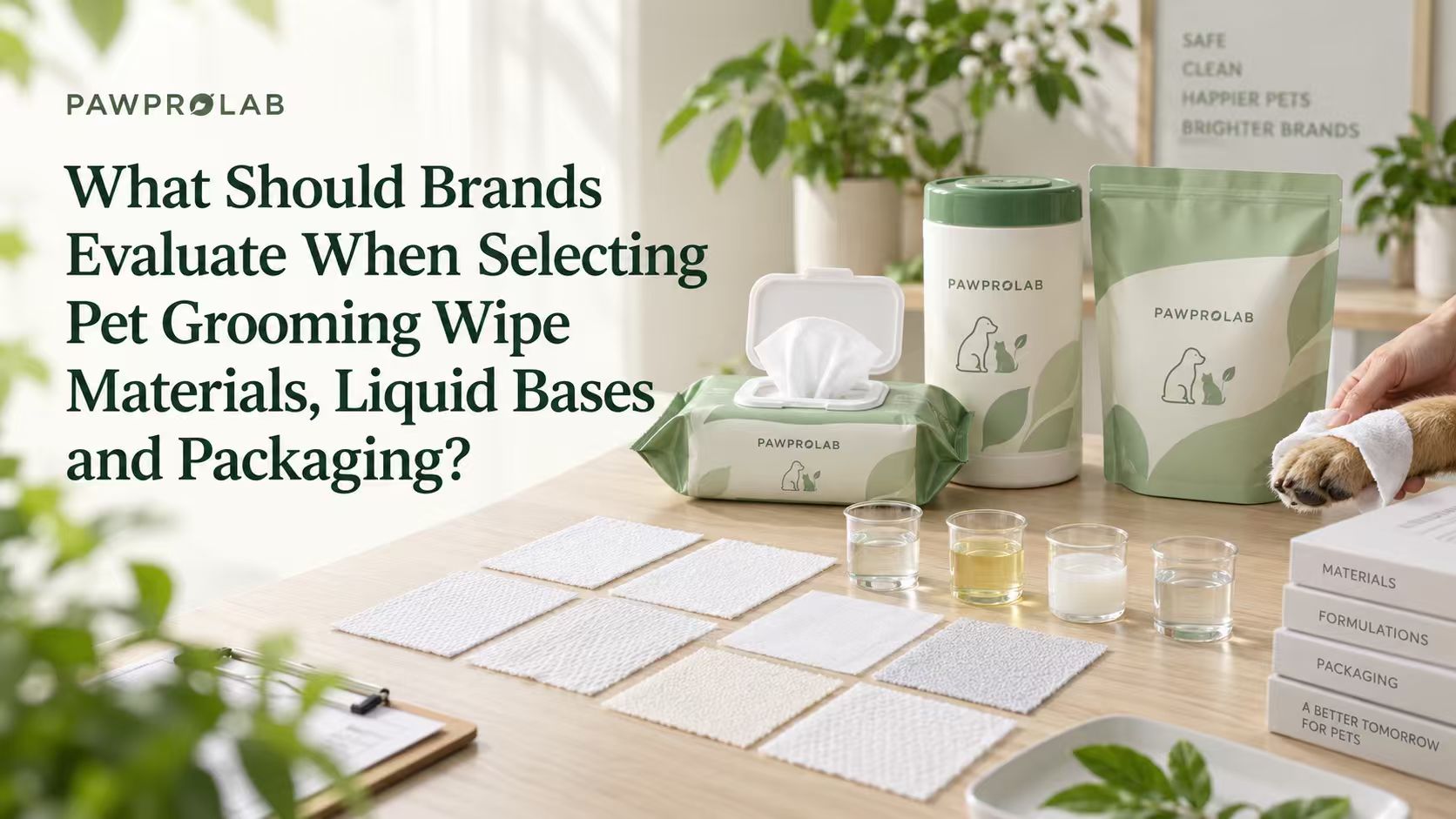
For a pet grooming wipes private label project, the wipe material is a functional part of the formula. A soft nonwoven may suit quick, gentle surface cleaning, while a thicker or subtly textured sheet may provide better pickup for paws and outdoor debris. The right choice is not simply “the thickest wipe.” It is the combination of tensile strength, softness, liquid carrying capacity, dispensing behavior, and cost that matches the brand’s use case.
Brands should request substrate swatches and finished wipe samples before locking a format. The same lotion can feel dramatically different on two materials. One substrate may release liquid too quickly and feel drippy; another may hold too little lotion and drag across the coat. A custom pet wipes manufacturer should be able to help compare wipe basis weight, texture direction, roll conversion, and pack dispensing before final artwork is approved.
| Specification | What to assess | Why it matters |
|---|---|---|
| Substrate composition | Soft nonwoven, plant-based direction, or other approved material route | Controls feel, liquid holding and brand sustainability story |
| Basis weight and thickness | Resistance to tearing, perceived quality, one-wipe coverage | Prevents a thin or flimsy consumer experience |
| Surface texture | Glide on coat and light debris pickup | Supports practical clean-up without excessive friction |
| Wipe dimensions | Paw, body, travel, and large-pet needs | Influences usage instructions, count, and perceived value |
Balance Lotion Load, Cleaning Performance, and Low-Residue Feel
The liquid phase should be evaluated as a consumer experience, not just an ingredient list. A good fragrance-free wipe provides enough slip to lift daily dirt and freshen the coat, yet leaves a clean finish after the wipe-down. Too much liquid can make the product feel saturated, create packaging leakage risk, and leave a heavy film. Too little liquid can cause drag, inconsistent cleaning, and a perception that the pack has dried out prematurely.
For a private label fragrance-free pet wipes program, brands should include tactile assessment in sample approval. Ask evaluators to compare initial wetness, glide, visible residue, hand feel after handling the used wipe, and coat feel after a short dry-down. Those observations are often more commercially useful than generic language such as “gentle” or “premium.” They also help prevent returns caused by complaints that the product is too wet, too dry, sticky, or perfumed.
Use a low-residue acceptance checklist
- Wetness consistency: The first, middle, and last wipe in a pack should not feel materially different.
- Cleaning feel: The wipe should lift everyday surface soil without a soapy or oily after-feel.
- Dry-down: The external coat surface should not remain tacky or look visibly coated after normal use.
- Fragrance-free integrity: The finished product should not introduce an avoidable perfume-like scent through unreviewed inputs or packaging interactions.
- Pack presentation: Excess liquid pooling, dripping from a fresh wipe, or uneven saturation should be treated as sample-stage issues.
Plan Preservation and Microbiological Validation as Core Development Gates
Because pre-moistened wipes are water-based systems, brands should not treat preservation as a back-end detail. The preservative approach, manufacturing hygiene, microbiological specifications, and packaging seal all influence whether the product remains stable throughout its intended shelf life. A responsible pet wipes OEM workflow defines the documents and test gates required for the target market before artwork and purchase orders lock the project into a pack format.
The manufacturer and brand should agree on what evidence is expected for the approved base, including relevant microbiological controls, stability observation, lotion uniformity, and pack integrity. This article is not prescribing a preservative formula. It is defining the procurement question: can the proposed liquid system remain controlled on the chosen substrate, in the chosen packaging, across manufacturing and customer use conditions?
Design Resealable Packaging That Resists Dry-Out
Packaging is one of the largest quality levers in a fragrance-free wipe project. The best formula cannot perform if a soft pack loses moisture after a few openings, a flip-top does not reseal consistently, or the dispensing opening pulls several wipes at once. For home use, a flip-top soft pack or canister may provide a strong daily routine. For portable use, a smaller resealable pack may be better—but only if the closure and barrier film support the expected open-close cycle.
Brands should request packaging validation that reflects how people actually use wipes: repeated opening, closure contamination, variable storage orientation, delivery vibration, and time between uses. A “sealed at factory” check is not enough. For a private label pet wipes project, moisture retention after opening is part of the product promise and should be reviewed alongside the formula.
| Packaging route | Best fit | Validation questions |
|---|---|---|
| Flip-top soft pack | Daily household use | Does the lid reseal reliably? Is dispensing controlled? Does moisture remain uniform? |
| Travel soft pack | Car, walks, short trips | Does the label reseal after multiple pulls? Does the pack resist leaks and edge lifting? |
| Canister or tub | Higher-count home or grooming use | Does the closure prevent dry-out? Does the wipe pull smoothly without tearing? |
| Refill format | Repeat purchase or lower-plastic positioning | Can the refill transfer without contamination or moisture loss? |
Build a Fragrance-Free Wipe SKU System for Home and Travel
Brands can develop a coherent wipe line without duplicating the same product in different counts. A sensible architecture might begin with one fragrance-free daily grooming wipe in a household pack and a travel pack. The same product brief can then be adapted only where the use case genuinely changes—for example, a thicker wipe for outdoor paws or a larger count for professional grooming.
Keep the claims hierarchy disciplined. The fragrance-free wipe can be positioned around daily external wipe-down, between-bath freshness, and a clean finish. It should not borrow medical, therapeutic, or antimicrobial claims from unrelated categories. For brands also considering a spray, PawLab Pro’s existing Pet Odor Eliminator Spray Formulation guide explains why spray mechanics and wipe mechanics need separate development briefs.
What Brands Should Confirm Before Moving to Samples
- Product role: Confirm daily external clean-up, target areas, target animals, and label boundaries.
- Fragrance-free definition: Confirm the no-added-fragrance direction, documentation needs, and final market labelling review.
- Substrate brief: Select material, thickness, texture, dimensions, and strength target based on the cleaning task.
- Lotion target: Define wetness, glide, dry-down, residue tolerance, and the expected feel after use.
- Quality gate: Agree on microbiological, stability, moisture-retention, seal, leak, and dispensing checks.
- Packaging route: Confirm household pack, travel pack, canister, refill, count, artwork space, and MOQ implications.
- Sampling method: Test the actual substrate, formula, and final-like packaging together—not as isolated components.
Conclusion
A successful fragrance-free pet wipe is built through specification discipline. Brands that define the cleaning scope, substrate, lotion load, preservation strategy, and reseal performance early can create a product that feels genuinely useful between baths instead of like a generic wet wipe. For teams comparing an OEM route, the right question is not simply “Can you make fragrance-free wipes?” It is whether the supplier can turn the intended experience into measurable sample, packaging, and quality-control decisions.
To begin a product brief, review PawLab Pro’s pet care product development options or contact the team with your preferred wipe size, count, target market, fragrance policy, and packaging concept.
References
- Zerun Cosmetic: Private Label Pet Wipes OEM/ODM Guide.
- Neva Global: Private Label Pet Extra Care Wet Wipes Manufacturer.
- Earth Rated: Dog Grooming Wipes Product Information.