Pet-care OEM insights
What Should Brands Evaluate When Selecting Pet Grooming Wipe Materials, Liquid Bases and Packaging?
Guide OEM pet grooming wipe buyers through substrate, liquid base and packaging choices, with sample checks for wetness, dispensing and pack integrity.
A pet wipe is not simply a lotion poured into a pack. For a brand, it is a coordinated system made of substrate, liquid base, fold, dispensing opening, closure and usage instruction. If any one part is selected in isolation, the finished product can feel too thin, too wet, too dry, difficult to pull from the pack, or inconsistent after repeat opening. That is why a pet grooming wipes OEM brief should begin with a specification decision—not an ingredient wish list.
TAKEAWAYS
- Select a system, not three separate components: substrate, liquid load and closure must be sampled in the intended finished pack.
- Make the wipe job specific: a paw clean-up, a coat wipe-down and a travel format can require different sheet feel, wetness and dispensing behavior.
- Use material language that procurement can approve: composition, basis weight, texture, dimensions, fold, sheet count and liquid load should be agreed before artwork is locked.
- Evaluate liquid experience after wiping: brands should observe wetness, glide, residue, dry-down and pack-to-pack consistency instead of relying on generic “premium” language.
- Treat packaging as a quality gate: reseal performance, moisture retention, wipe pull and leak resistance influence customer experience as much as the liquid base.
Why Material, Liquid Base and Packaging Must Be Evaluated Together
A private label pet wipes manufacturer can offer many material and pack combinations, but a useful buyer brief starts with the external-use job. Is the wipe intended for a light between-bath coat refresh, a paw-and-body wipe-down after a walk, a portable travel pack, or a higher-count grooming format? That decision affects how much liquid the sheet should carry, how much texture is appropriate, and whether a soft pack, flip-top lid, canister or single-use route makes commercial sense.
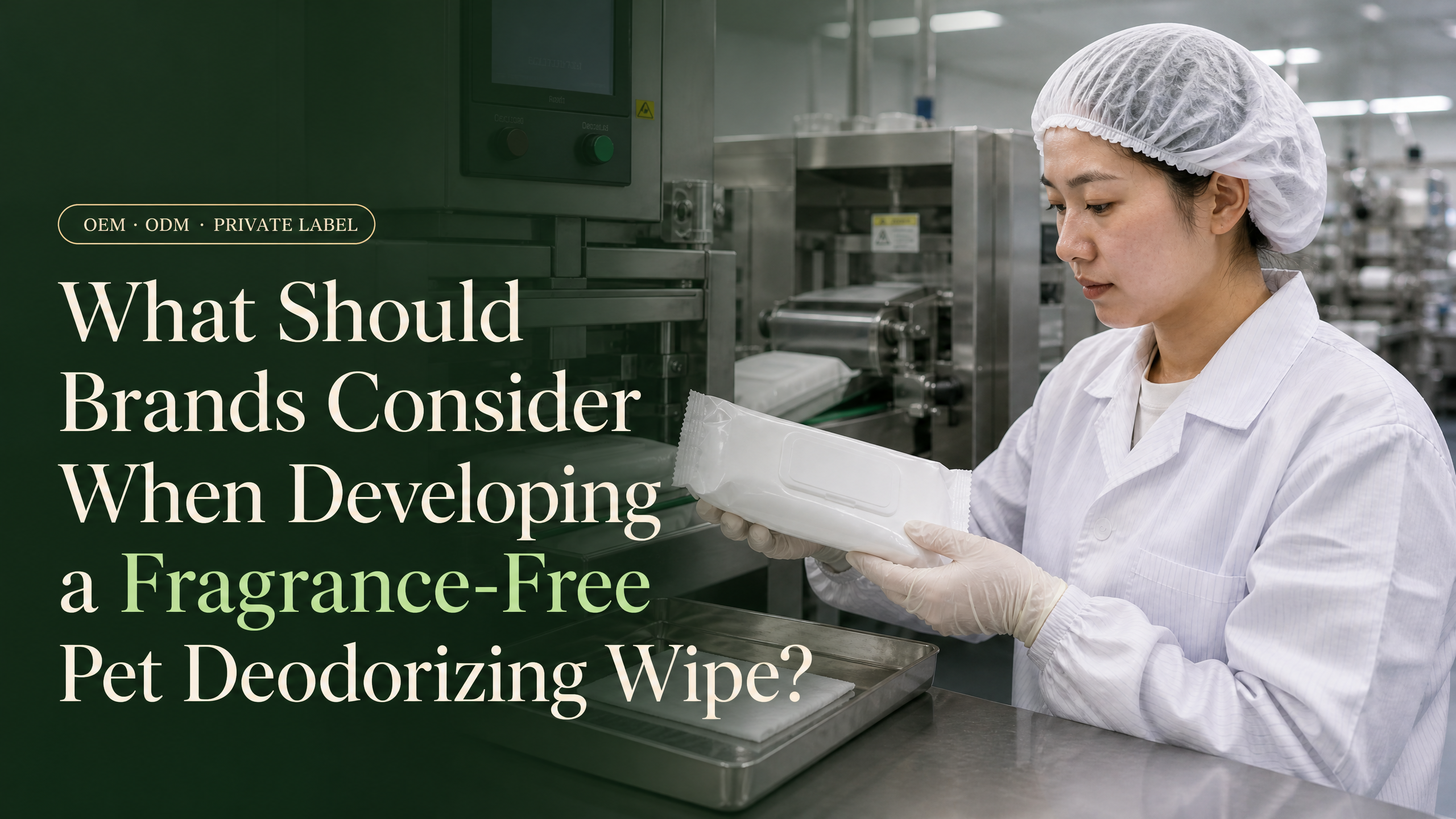
This article is a specification guide for a routine grooming wipe. It is not a guide to medical wipes, eye or ear products, antimicrobial claims, disinfecting products, or a substitute for the existing Fragrance-Free Pet Deodorizing Wipe article. That article starts with a fragrance-free product concept. This one starts earlier: it helps a buyer select the complete material–liquid–pack system that will be sent for samples.
| Decision layer | What the brand evaluates | What can go wrong if it is isolated |
|---|---|---|
| Substrate | Softness, texture, wet strength, lint perception, sheet size and fold | A liquid base may feel drippy, drag on the coat or tear during use on the selected fabric. |
| Liquid base | Wetness, glide, dry-down, scent direction, residue perception and compatibility plan | A suitable formula may feel heavy or uneven once it is held in a different nonwoven. |
| Packaging | Opening, dispensing, reseal, barrier, seal and transport behavior | Even a good wipe may dry out, leak or pull multiple sheets after repeated use. |
Start with the Grooming Use Case Before Choosing a Wipe Material
There is no universal “best” wipe substrate. A brand selecting a custom pet wipe material should define the cleaning occasion, expected level of surface soil, preferred hand-feel and channel before choosing a sheet. A low-profile travel wipe, for example, may prioritize compact folding and controlled dispensing. A home grooming wipe may prioritize one-sheet coverage, soft handling and an easy-to-reseal lid. A professional grooming format may have a different count, pull pattern and storage expectation.
For external grooming use, the material selection should also be tied to a clear instruction boundary. A brand may develop a wipe for paws, body surface or coat wipe-down between baths. It should not automatically be presented as appropriate for eyes, inside ears, wounds, inflamed skin or any other sensitive area unless the finished product, evidence and market review support that exact use.
Substrate questions for an OEM sample brief
- Composition direction: Does the buyer want a specified nonwoven route, a viscose-blend direction, a cellulose-derived option, or another approved material system?
- Basis weight: What level of thickness, tear resistance and one-wipe coverage does the intended use require?
- Surface: Is a smooth surface, a light emboss, or a more tactile texture better aligned with the expected wipe-down task?
- Dimensions and fold: Can the sheet size, folded size and pull direction work with the intended pouch or canister?
- Finished feel: Does the saturated wipe remain soft and easy to unfold without linting, bunching or tearing in normal handling?
Compare material samples against the same liquid base
When a buyer asks for a spunlace pet wipes manufacturer or another material route, it is useful to request comparable sample sets rather than approving a dry swatch alone. The same liquid base can release quickly from one material and remain too concentrated in another. Comparing finished samples helps a team assess initial wetness, liquid transfer, glide across the coat, wipe integrity and the perception of residue after a short dry-down.
| Material criterion | Sample-stage observation | Buyer decision supported |
|---|---|---|
| Dry and wet strength | Does the sheet open, wipe and discard without tearing in normal use? | Basis weight and material construction target |
| Texture and glide | Does the surface move across the target coat area without a rough or dragging feel? | Smooth versus lightly textured surface direction |
| Liquid release | Does the wipe feel balanced, or does it pool, drip or become too dry during use? | Substrate–liquid-load pairing |
| Lint and visual finish | Does normal handling leave visible fibers or an unwanted coated appearance? | Material and post-wipe finish threshold |
| Pack dispensing | Does the selected fold pull one sheet at a time from the intended opening? | Fold, perforation and opening specification |
Build the Liquid Base Around Wetness, Glide and Post-Wipe Feel
For a pet wipe liquid formulation OEM project, the liquid phase is a user-experience decision as well as a formula-development decision. The brand should describe how the wipe needs to feel when it leaves the pack, how it should move across the coat or paw, and what the surface should feel like after a normal dry-down. A finished wipe that is overly saturated can feel messy and create pack leakage risk. A wipe that carries too little liquid may feel dry, drag on the coat or create a poor value perception.
Do not ask only whether a base is “gentle.” Ask for a sample evaluation plan. The plan can compare first, middle and final sheets from a pack; wetness after storage; liquid distribution; visible pooling; glide; residue; and any scent contributed by the formula or packaging. This creates practical acceptance criteria for both a brand and its pet grooming wipes OEM partner without treating a broad marketing word as a performance specification.
Liquid-base elements to define before sample approval
- Liquid load target: Specify the intended wetness level and acceptable variation across a finished pack.
- Cleaning direction: Define routine external wipe-down and the type of everyday surface soil the product is intended to address.
- After-feel: State whether the desired finish is near-invisible clean, a lightly conditioned perception, or another sample-evaluated direction.
- Fragrance policy: Decide whether the project calls for fragrance-free, low-scent or another reviewed fragrance direction.
- Stability and preservation review: Agree on the evidence and test gates expected for the chosen liquid, substrate and target market.
- Compatibility: Evaluate the base in the intended material and pack, not in a generic laboratory container only.
A request for an alcohol-free, low-scent or plant-derived direction should be recorded as a product brief, not treated as an automatic finished-product claim. Similarly, a fragrance-free option is not a substitute for completed formula review, preservation work, packaging compatibility checks and market-facing label approval.
Use Packaging to Control Dry-Out, Dispensing and Perceived Quality
A pet wipes packaging manufacturer discussion should begin with the customer’s opening behavior. Soft packs, flip-top lids, canisters, refills and individual sachets create different user experiences. The right choice depends on sheet count, channel, expected repeat opening, travel needs and the brand’s desired price architecture. More importantly, the closure needs to preserve the material–liquid system after the pack has been opened, not only when it first leaves the factory.
For a flexible pack, brands should review the film structure, opening geometry, resealable-label or lid behavior, sheet-pull control, seal integrity and leakage behavior. For a flip-top format, they should consider hinge durability, lid reseal consistency and the risk of multiple sheets being pulled at once. A canister may be appropriate for a high-count routine, but it still requires an evaluation of closure performance and the way the first, middle and last wipe dispense.
| Packaging route | Possible B2B use case | Questions to validate in samples |
|---|---|---|
| Resealable flow-wrap soft pack | Daily or travel grooming wipe | Does the seal reclose consistently? Do edges lift? Does moisture remain even after repeated pulls? |
| Flip-top soft pack | Higher-frequency household use | Does the lid close cleanly? Is single-sheet dispensing controlled? Is the opening comfortable to use? |
| Canister or tub | Higher-count home or professional grooming format | Does the closure limit dry-out? Does the roll or stack pull smoothly without tearing? |
| Single sachet | Sampling, travel, hospitality or add-on format | Does the sachet open cleanly? Are final fill, seal and carton requirements appropriate for the channel? |
| Refill pack | Repeat-purchase system under a reviewed sustainability brief | Can consumers transfer or reload the wipes without unacceptable moisture loss or handling issues? |
Test the Complete Wipe System Before Artwork and Bulk Production
The most useful private label pet wipes manufacturer sample is not a dry material swatch, a cup of lotion and an empty pouch shown separately. It is a finished-like sample with the intended material, liquid base, fold, count and closure. That is the only way a brand can understand whether the product delivers the intended wetness, pull, feel and repeat-opening experience together.
Before approving a production route, align the quality and commercial teams around a small acceptance matrix. PawLab Pro’s guide to evaluating pet care formula samples can support the sample-review workflow, while the pre-launch packaging validation checklist is relevant when the team is ready to review seal, label and distribution risks.
| Approval gate | What to record | Why procurement needs it |
|---|---|---|
| Material sample | Composition direction, basis weight, texture, sheet dimensions and wet strength observations | Creates an approved fabric language before bulk conversion. |
| Liquid sample | Wetness, glide, residue perception, scent direction and compatibility observations | Turns subjective feel into a reviewable sample brief. |
| Finished-pack sample | Fold, pull, opening, reseal, leakage, moisture retention and artwork fit | Prevents a good formula from entering an unsuitable package. |
| Market review | Use instructions, caution language, claims, ingredient information and sustainability language | Confirms the final commercial wording is appropriate for the launch market. |
Build a Wipe Line Without Confusing the Buyer
A wipe range does not need a separate formula for every sheet count. A brand can begin with one clearly positioned external-grooming wipe and vary only the format where use genuinely changes: a household flip-top pack, a smaller travel pack, or a professional count. The material, wetness and closure decisions should continue to support the same product promise. For a broader no-rinse routine, compare the wipe route with PawLab Pro’s Waterless Pet Bath article, which addresses a foam-led format rather than a fabric-and-lotion system.
Where a brand wants to explore fragrance-free positioning, link the range architecture back to the existing Fragrance-Free Pet Deodorizing Wipe guide. This avoids treating fragrance policy as the same decision as substrate selection or packaging performance.
Conclusion
For a pet grooming wipe, material, liquid base and packaging are not separate purchasing lines. They create the real product experience together. Brands that define the grooming job, choose a substrate with the correct wet feel, set practical liquid-base acceptance criteria, and test the actual closure before artwork approval are more likely to launch a wipe that performs consistently in daily use.
To start a custom project, contact PawLab Pro with the intended application, target market, material preference, wipe size, sheet count, fragrance policy, wetness direction and preferred packaging route. A sample brief built from those inputs is more useful than a generic request for “pet wipes.”
Frequently Asked Questions
What should a brand provide when requesting a custom pet wipe quote?
Provide the intended grooming use, target market, wipe material preference, dimensions, sheet count, liquid-base direction, fragrance policy, packaging route, artwork status and expected launch quantity. A custom pet grooming wipes private label inquiry is easier to evaluate when the supplier can see how the complete wipe system is intended to work.
How should a brand compare biodegradable or sustainability-led pet wipe materials?
Treat this as an evidence and market-review question. Ask for the specific material composition, available documentation, disposal context and final claim support. Do not assume that a material direction automatically supports a biodegradable, compostable, plastic-free or flushable marketing claim.
What is the best packaging route for pet grooming wipes?
There is no universal best route. A travel wipe may need a compact resealable pouch; a daily household format may benefit from a flip-top pack; and a higher-count use case may need a canister. The right answer comes from testing dispensing, reseal performance, moisture retention and shipping behavior with the chosen material and liquid base.
References
- Cleanora Wipes: Pet Wipes Options for Custom and Wholesale Orders.
- Diamond Wipes: Contract Packaging.
- SYWIPE: Wet Wipes Manufacturing Raw Materials.