Pet-care OEM insights
Hypochlorous Acid in Pet Grooming Products: Stability, Packaging, Claim Limits and OEM Checks
Plan HOCl pet grooming products with sample checks for free available chlorine, pH, packaging, format controls and claim limits before private-label launch.
Hypochlorous acid (HOCl) should be treated as a controlled finished-system project, not as a single concentration number or an ingredient story. A brand considering an HOCl spray, rinse, ordinary wipe or glove wipe needs a written record for free available chlorine, pH, storage and open-pack exposure, package route, intended format, target market and proposed wording. The point is to decide what must be evaluated in a representative configuration before anyone assumes that a material, a bottle or a claim is ready for launch.
This is a B2B guide for OEM/ODM buyers, Private Label brands, distributors, retailers and professional procurement teams. It does not prescribe an HOCl level, pH range, bottle color, package, use direction, target area, market classification, safety outcome, performance result or shelf life. It does not say that one finished format can stand in for another. Instead, it turns a high-risk product idea into an OEM control brief that a brand can use for samples, quotations and qualified market review.
TAKEAWAYS
- Do not select an HOCl project by one concentration number. Free available chlorine, pH, solution history, package, closure, storage assumptions and the proposed finished use belong in one version-controlled review.
- Spray, rinse, ordinary wipe and glove wipe are distinct sample systems. A result from one route does not automatically apply to another format, substrate, pack, closure or opening pattern.
- Transparent and light-protective packs are commercial candidates, not conclusions. Evaluate each actual formula–component–closure combination under a project-specific plan rather than treating a broad packaging preference as proof.
- “Clean” and “Freshen” are draft commercial wording, not automatic classifications. “Kill bacteria,” “disinfect,” “sanitize,” “treat” and “heal” require escalation before artwork or sales copy is treated as final.
- Ask the OEM for a controlled feasibility record. It should identify the exact formula version, free-available-chlorine method, pH method, packaging candidate, format, timepoints, storage conditions, approval owners and outstanding market/claim questions.
1. Start With the Finished Format, Not an HOCl Ingredient Story
Interest in HOCl pet grooming products is expanding beyond one spray concept. A 2025 HICC Pet announcement described sprays and rinses in an HOCl product line shown at Global Pet Expo. [1] That is a market-format signal, not independent evidence about any brand’s stability, animal use, claim support or launch status. A buyer should not turn a competitor’s launch language into an OEM specification.
The first development decision is the actual finished route. A hypochlorous acid pet spray, a rinse, a conventional wipe and a glove wipe create different control questions. A buyer may use the search phrase private label pet skin spray, but that phrase cannot decide a use direction, species suitability, claim route or market status. The liquid may have a different headspace and repeat-opening pattern. A wipe also adds a nonwoven substrate, liquid load, fold, closure and sheet-pull behavior. A glove wipe adds material construction, contact geometry and a potentially different use path. Each configuration should have its own sample identity and approval record.
| Commercial Route | What the Brief Must Identify | What Cannot Be Assumed |
|---|---|---|
| Spray | Formula version, bottle and trigger candidate, closure state, intended external application boundary, storage route and draft wording | That a bulk solution or a different sprayer predicts the finished retail route |
| Rinse | Formula version, flow/closure route, use-direction draft, package size and whether the configuration is open, capped or repeatedly handled during review | That a spray result transfers to a rinse without representative testing |
| Ordinary wipe | Liquid load, substrate, fold, count, pack film, closure, first/middle/last-sheet sampling and intended external grooming boundary | That the liquid in a laboratory container behaves the same after saturation and repeat opening |
| Glove wipe | Glove material, liquid load, seam/construction, pack and closure route, external grooming boundary and sample handling plan | That a flat wipe automatically represents a glove-wipe system |
2. Put Free Available Chlorine and pH Into One Control Record
For an HOCl proposal, free available chlorine and pH are project controls, not standalone commercial claims. A published discussion of one stabilized HOCl solution explains that chlorine-species distribution is pH-dependent and that open-system headspace loss can be relevant. [2] That work concerns a specific wound-care formulation; it is not data for pet grooming, a formula target, a pet-use direction, a retail shelf life or an approval of any private-label product.
The correct OEM question is therefore not “What is the universal best number?” It is “What did this defined version measure, by which method, at which point in its sample history, inside which package, and what decision does the brand intend to make from that observation?” This avoids a common procurement failure: approving a specification sheet while the formula, component, format or use context is still changing.
| Control Field | Record for the Actual Project | Escalate When |
|---|---|---|
| Free available chlorine | Method, result unit, sample ID, formula version, collection point, date and reviewer | The formula, water source, process, package, storage assumption or requested product statement changes |
| pH | Method, result, temperature/context if relevant, sample ID, timepoint and reviewer | A result is used as a substitute for finished-system stability or a claim is proposed from one reading |
| Sample history | Manufacture date, fill date, storage route, whether sealed/opened, opening count where relevant and current component version | The brand cannot trace a measured result to a representative configuration |
| Decision purpose | Technical feasibility, conditional sample review, component selection, claim/market review or another named stage | A preliminary result is being reused as a launch or performance conclusion |
Brands that already use PawLab Pro’s pH, viscosity, foam and rinseability article should keep the distinction clear. That article addresses rinse-off shampoo production parameters. An HOCl format needs a separate record for its reactive liquid, package and claim route; shampoo controls do not replace it.
3. Treat Light, Temperature and Opening as Stability Questions
For an HOCl sample, the practical issue is not whether a brand can name a preferred storage condition. It is whether the brand has approved an evaluation plan for the version it intends to sell. The plan should specify the formula version, component version, closure state, storage conditions, timepoints, observations, measured controls, owner and action threshold. It should distinguish sealed-pack review from repeat-opening review because those are different sample histories.
A transparent, tinted or opaque component can each be an input to compare. No packaging choice should be presented as automatically correct, because the relevant question is the behavior of the proposed finished system. The same rule applies to a secondary carton, a refill route, a travel pack or a warehouse/distribution assumption. The product is not only the liquid; it is the liquid plus the final component and its intended handling path.
| Evaluation State | Project Question | Record Needed Before a Decision |
|---|---|---|
| Sealed commercial candidate | How does the defined formula–package–closure configuration track through the agreed review conditions? | Formula and component versions, storage plan, timepoints, observations, measured controls and release owner |
| Repeat-opened spray or rinse candidate | What opening/closing or handling pattern is being represented, and how will it be documented? | Opening count or defined routine, closure state, sample ID and any re-test trigger |
| Finished wipe pack | How do liquid load, substrate, closure and repeated pulls affect first/middle/last-sheet review? | Pack version, sheet positions, opening pattern, moisture/appearance observations and change owner |
| Distribution assumption | Which agreed handling and exposure assumptions are actually being reviewed? | Written scope and a clear statement of what the plan does not represent |
4. Select Packaging by Representative Samples, Not by Bottle Color Alone
“Clear bottle versus protective bottle” is a useful commercial comparison, but it is not a yes-or-no chemistry answer. The buyer should request samples in the candidate components and score them against the same agreed plan. For a spray, that may include the bottle, trigger, overcap and stored/opened status. For a rinse, it may include the cap, flow route and repeated handling pattern. For a wipe, it must include substrate, liquid load, fold, film and closure. A HOCl pet wipes OEM request is incomplete if it describes only the liquid.
This sample discipline also protects commercial timing. Artwork often advances before the final component has been frozen. A brand can use a conditional version record instead: note which package is provisional, what evidence is pending and which change requires a new representative sample. PawLab Pro’s pre-launch packaging validation checklist can support the broader component, label and distribution discussion, but it does not substitute for an HOCl-specific stability and claim-control record.
| Packaging Question | Sample-Control Question | Do Not Convert It Into |
|---|---|---|
| Clear, tinted or opaque route | Which candidate component is being reviewed with the defined formula and agreed conditions? | An automatic shelf-life or protection statement |
| Trigger or pump output | Which component version, closure state and use simulation are part of the representative sample? | A claim that every trigger, pump or batch will behave identically |
| Wipe pack and substrate | How will material, liquid load, first/middle/last sheets, pull and reseal behavior be recorded? | Evidence from a bulk liquid or a different wipe configuration |
| Secondary pack and artwork | Does the draft wording identify the actual format, directions and unresolved market review? | Finalization of claims or product classification |
5. Keep Spray, Rinse, Wipe and Glove-Wipe Claims Separate
Each format should have a claim map that follows the proposed product rather than the ingredient. A body/coat spray, a rinse, a paw wipe and a pet-accessory surface product can raise different intended-use questions. The buyer should identify the requested external-use boundary and avoid moving a phrase from one format to another without reviewing the final formula, directions, market and evidence.
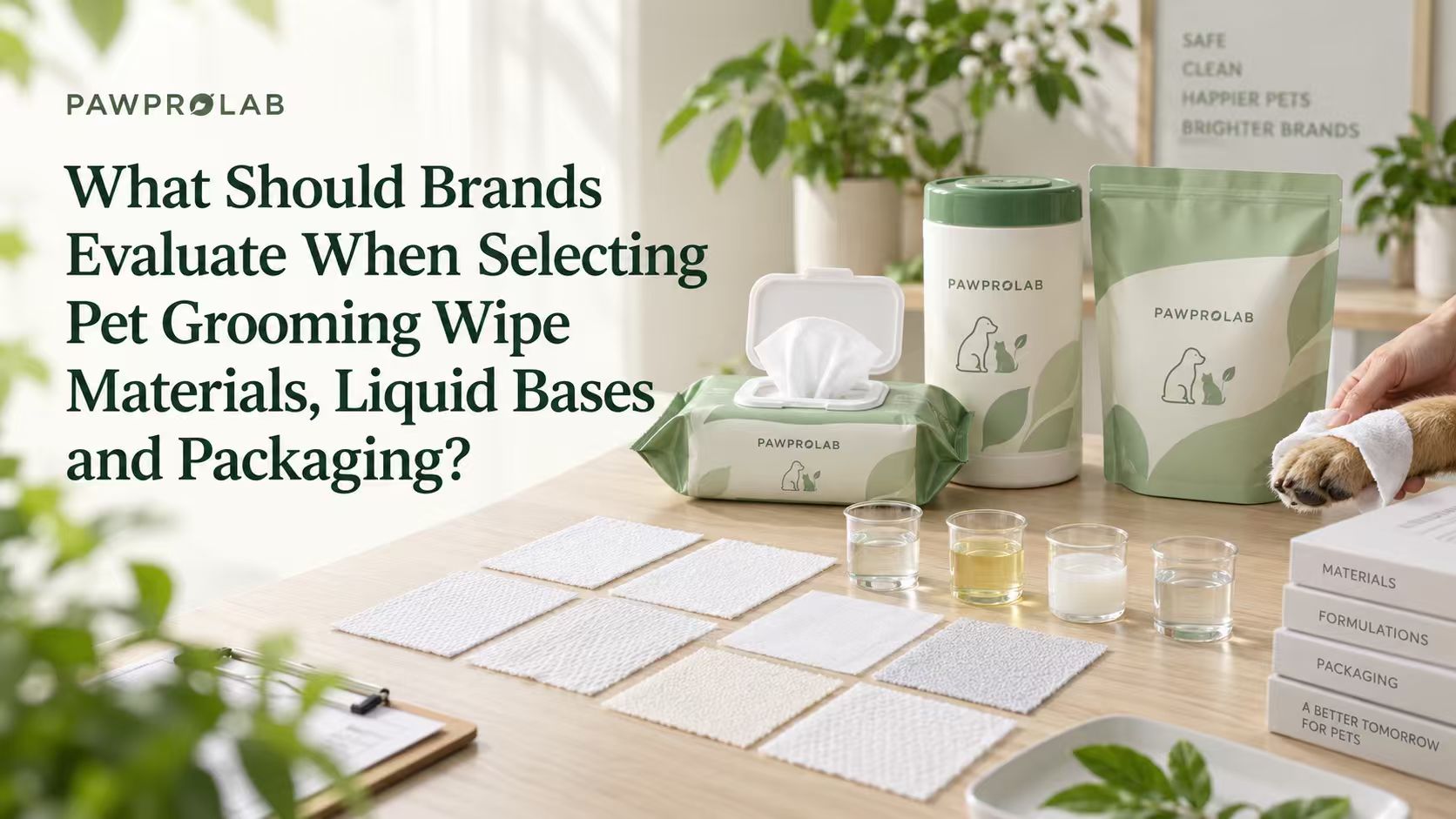
For the material–liquid–pack system questions that apply to wipes, see PawLab Pro’s grooming wipe materials, liquid bases and packaging guide. For a broader no-rinse grooming concept, see how to develop a waterless pet bath product. Neither article establishes an HOCl claim, formula, concentration, animal-use route or market decision.
| Draft Wording Direction | Why It Needs Review | Buyer-Side Next Step |
|---|---|---|
| “Clean” or “Freshen” | Even routine grooming language must match the actual format, directions, market and evidence plan. | Keep as draft copy; route the final formula and artwork through qualified market review. |
| “Kills bacteria,” “disinfects” or “sanitizes” | EPA describes antimicrobial pesticides as products intended to destroy or suppress harmful microorganisms on inanimate objects and surfaces. [3] | Stop routine copy approval and escalate the exact product, use, market and proposed claim for specialist review. |
| “Treats,” “heals,” disease language or structural-function language for animals | FDA’s nonbinding guidance explains that direct or implied disease or structure/function claims can cause an animal product to be considered a drug. [4] | Remove from ordinary grooming copy until the correct qualified review resolves the intended route. |
| “Safe for every pet,” “hypoallergenic” or “clinically proven” | A generic ingredient, pH reading or component choice does not establish universal suitability, allergy prevention or evidence for a finished-product message. | Do not use as a launch shortcut; define the exact claim and evidence question. |
6. Make U.S. and EU Review a Product-Specific Gate
For the U.S., FDA’s Animal Grooming Aids CPG explains that products intended solely to cleanse or beautify animals may be treated as grooming aids, while direct or implied disease or structure/function claims may change that analysis. [4] EPA explains that pesticide registration considers the proposed use, label language and supporting data; the agency’s antimicrobial page addresses products used on inanimate objects and surfaces. [5] These materials are boundaries for questions, not a classification or market decision for a particular pet-care product.
For the EU, the Biocidal Products Regulation defines a biocidal product by the intention to control harmful organisms. [6] Commission Implementing Regulation (EU) 2021/347 addresses active chlorine released from HOCl for certain biocidal product types, including veterinary hygiene product type 3, subject to conditions. [7] Active-substance context does not authorize a brand’s final spray, rinse, wipe or glove wipe. A buyer should route the actual formula, intended use, product format, target Member State and proposed copy to the appropriate qualified review before any launch decision.
This article is not veterinary, medical, legal, pesticide-registration, biocidal-product, market-authorization, antimicrobial, therapeutic, allergy-prevention, universal-suitability, certification, safety, ingestion-safety or guaranteed-performance advice. It is a procurement framework for controlling a proposed HOCl grooming project before product wording is treated as settled.
7. Use an OEM Release Record That Survives Change
A hypochlorous acid pet product manufacturer inquiry should ask for a release record, not a generic “HOCl formula.” The record allows the brand, supplier and reviewers to see what was actually assessed and what remains conditional. It also stops an old result from being reused after a formula, packaging, claim or market change.
For the general discipline of recording sample identity, appearance, packaging fit and approval ownership, see PawLab Pro’s formula-sample evaluation guide. The added HOCl requirement is to preserve the free-available-chlorine, pH, package, opening-history and claim-review controls in the same project record.
| Release State | What Is Known | What Must Happen Next |
|---|---|---|
| Technical feasibility | Initial format direction, formula version, proposed controls and commercial component candidates | Confirm the representative configuration and written sample criteria |
| Representative-sample review | Defined formula, format, component, closure and test/observation plan | Record results, unresolved issues and any requested revision |
| Conditional commercial route | Technical sample discussion may be complete, but component, artwork, claims or market questions remain open | Keep exclusions visible; do not describe the product as fully approved or ready for every channel |
| Market and copy review | Actual final formula, intended use, target market, label/directions and promotional language | Obtain the applicable qualified review before release |
Any controlled change should reopen the right gate. Formula version, free-available-chlorine method, pH method, component, closure, substrate, liquid load, fill, artwork, market, intended use or claim wording can change what the original sample proves. The buyer should decide in advance whether that change requires a document review, a new representative sample, or an additional market/claim review.
FAQ: HOCl Pet Grooming Product Development
Can a brand choose an HOCl pet product only by free available chlorine?
No. A single measurement does not stand in for formula version, pH, sample history, package, closure, format, storage plan, opening pattern, intended use, market or claims. Record the measurement as one control in a finished-system approval plan.
Is a transparent bottle automatically unsuitable for an HOCl project?
No. This article does not prescribe a packaging route. A clear, tinted or opaque component is a candidate to evaluate with the actual formula, closure and agreed storage/opening plan. The record should state exactly what was reviewed and what was not.
Can a spray sample support an HOCl wipe or glove-wipe launch?
No. A wipe adds substrate, liquid load, pack film, closure and repeat-opening variables; a glove wipe adds its own material and construction. Each finished configuration should have a separate representative-sample review.
Does EU active-substance context approve an HOCl pet grooming product?
No. The active-substance material does not authorize a particular brand’s finished product, intended use, wording or Member State launch. Route the actual product and copy through the appropriate qualified review for the target market.
Can “Clean” or “Freshen” be used without review?
No. They may be lower-risk than direct antimicrobial or therapeutic wording, but they are still draft commercial language. The final formula, use directions, format, target market and support for the finished product need to be considered before copy is released.
Request an HOCl Grooming Feasibility Brief
PawLab Pro can help a brand organize a technical feasibility discussion around one defined HOCl grooming format. Send the target market, proposed format (spray, rinse, ordinary wipe or glove wipe), intended external-use boundary, draft product wording, commercial packaging candidate, artwork status, desired sample questions, estimated launch scope and the team member who will approve the final record. The goal is not to promise a universal result. It is to identify one reviewable finished configuration and the questions that must be resolved before a quotation or sample route is treated as final. Contact PawLab Pro to begin the project brief.
References
- HICC Pet. HICC Pet Expands Its Pet Grooming & Wellness Line with 7 New Must-Have Products for the Modern Pet Parent.
- Wang L, et al. Hypochlorous Acid as a Potential Wound Care Agent: Part I.
- U.S. Environmental Protection Agency. What Are Antimicrobial Pesticides?
- U.S. Food and Drug Administration. CPG Sec. 653.100 Animal Grooming Aids.
- U.S. Environmental Protection Agency. About Pesticide Registration.
- European Parliament and Council. Regulation (EU) No 528/2012 concerning biocidal products.
- European Commission. Implementing Regulation (EU) 2021/347.