Pet-care OEM insights
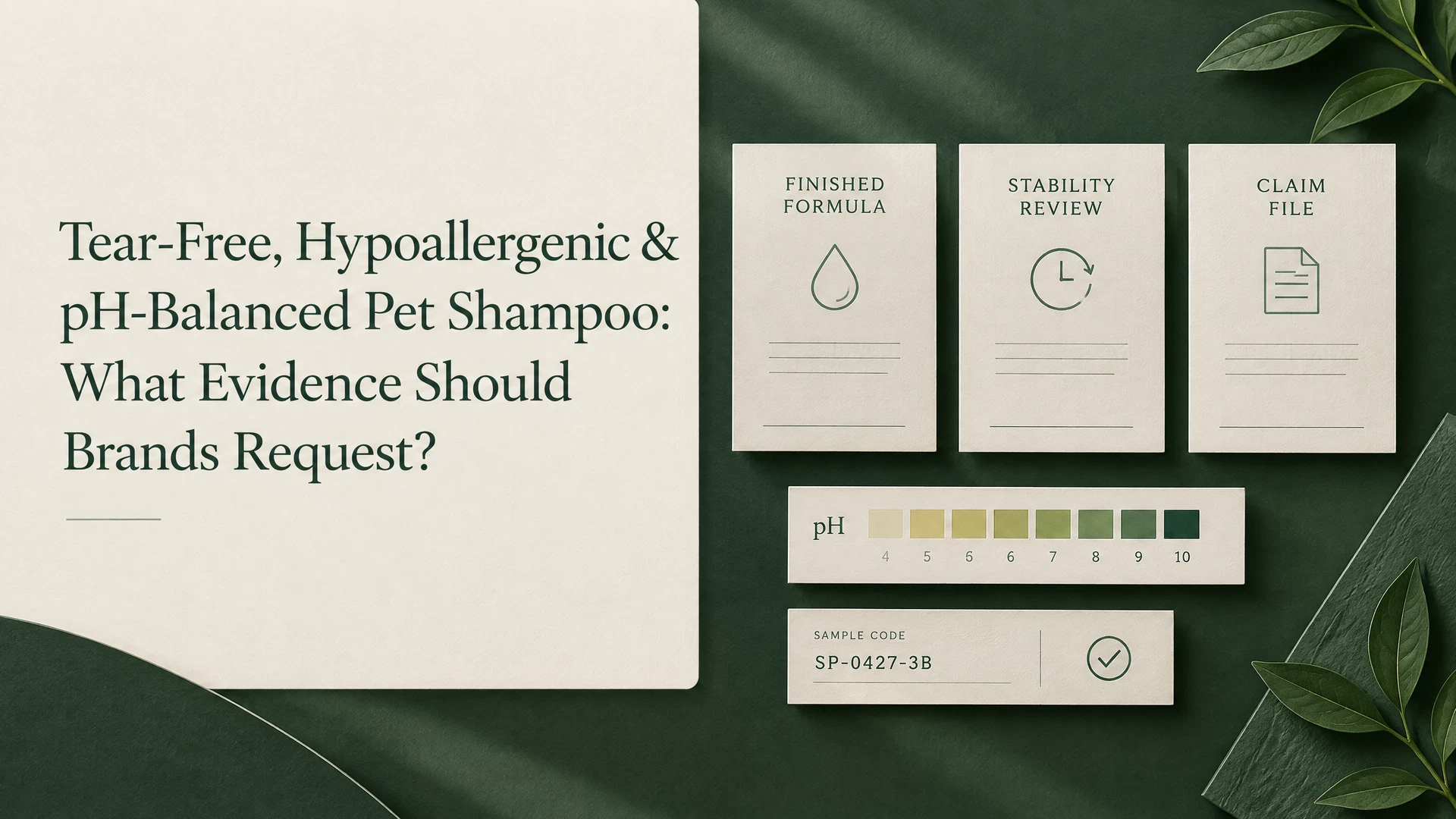
How to Set Pet Shampoo pH, Viscosity, Foam, and Rinseability Before Mass Production
Set a pet shampoo pH, viscosity, foam and rinseability specification before mass production, then verify stability, dispensing and coat-rinse performance.
For a private-label shampoo, the last sample is not ready for mass production because it looks good in a beaker. It is ready when the brand and manufacturer have agreed how the liquid will be measured, dispensed, foamed and rinsed after the storage conditions that matter to the launch. This is where pet shampoo formula testing becomes a manufacturing decision rather than a marketing phrase.
This guide gives brand owners, distributors and e-commerce teams a practical approval framework for pet shampoo pH, pet shampoo viscosity, foam and rinseability. It concerns a non-medicated rinse-off grooming product. It does not set a universal formula target, replace target-market review, or make treatment, allergy, antimicrobial or guaranteed performance claims.
TAKEAWAYS
- Set pH, viscosity, foam and rinseability as one linked release specification. A single attractive result does not establish a production-ready shampoo.
- Record the method with every target: sample temperature, dilution, instrument, storage condition, observation timing and acceptable band.
- Use high- and low-temperature storage checks to see whether the agreed pour, pump or squeeze experience remains aligned with the product brief.
- Approve foam for the intended bathing routine, then test how cleanly it rinses from the priority short, long or dense double-coat profile.
- Move to mass production only after the approved reference sample, packaging system, label wording and batch-control plan describe the same product.
1. Treat the Four Properties as One Mass-Production System
A buyer may begin with a narrow question: “Can you make an easy rinse dog shampoo?” The useful factory question is broader: what pH band, flow behavior, foam character and rinse endpoint should the finished shampoo meet after the agreed storage conditions, in the intended bottle and on the priority coat profile? That is a specification that can be sampled, recorded and transferred to a batch-release discussion.
These properties interact. A formula that becomes too thin after storage can dispense differently and spread too quickly through wet hair. A dense foam may look premium in a hand test but still leave an undesired rinse feel on a long or dense coat. A pH reading has meaning only when the brand and laboratory agree how it is measured. A 2022 descriptive study of 20 non-medicated dog shampoos reported a wide commercial spread in pH and viscosity, and separately evaluated foam and rinsing. The lesson for a B2B brief is not to copy a market average; it is to write a repeatable method and an acceptance band for the intended product. [1]
| Release Gate | Commercial Question | What Must Be Written Before Approval | What Not to Infer |
|---|---|---|---|
| pH | Is the reading aligned with the intended species, use instructions and finished formula brief? | Test method, dilution if used, temperature, target band and allowed change after storage | One pH value proves universal suitability |
| Viscosity | Does the shampoo pour or dispense as the selected pack and use routine require? | Instrument, spindle or method, sample temperature, target range and storage checkpoints | A thicker liquid is automatically a better shampoo |
| Foam | Does foam support distribution and the intended grooming experience? | Dilution, water, agitation, observation time, foam character and comparison sample | More foam proves stronger cleaning |
| Rinseability | Does the product release cleanly under the agreed bathing routine on the selected coat profile? | Water condition, application amount, rinse steps, coat panel and observation scorecard | One coat test represents every dog or cat |
For U.S.-facing projects, the product position should stay aligned with its formula, directions and claims. FDA’s compliance policy guide discusses animal grooming aids intended solely to cleanse or beautify animals. That makes a rinse-off cleansing brief, a final label review and disciplined evidence more useful than broad statements about skin conditions, infection, allergy relief or guaranteed gentleness. [2]
2. Set a Pet Shampoo pH Specification That Survives Storage
A pet shampoo pH target should begin as a product-specification decision, not a copied internet number. The intended animal scope, surfactant system, preservation strategy, fragrance direction, product form and target market all belong in the review. The manufacturer should then define the actual test conditions. If a reading uses a dilution, the dilution belongs on the specification. If the measurement temperature is controlled, it belongs there too. Without this context, a number cannot be compared honestly across samples or batches.
The cited commercial-shampoo study measured pH after a 1:10 dilution with bidistilled water and reported pH values from 5.6 to 8.4 among the products it examined. That is an observation from one product set and method, not an approved formula target for every private-label project. [1] The actionable OEM question is whether the approved formula remains within its own documented band at initial release and after the brand’s agreed storage checkpoints.
| pH Approval Field | Decision to Make | Evidence to Retain |
|---|---|---|
| Intended use and species scope | Define the finished product’s intended animal range and rinse-off directions | Approved formula brief and label-review record |
| Measurement method | Set dilution, water quality if relevant, temperature, meter calibration and replicates | Laboratory method sheet and sample log |
| Initial target band | Agree the acceptable release band for the finished formula, not an ingredient in isolation | Signed technical specification |
| Storage-change rule | Define the maximum acceptable movement after the selected stability checkpoints | Time-point results and visual observations |
| Change control | Decide when fragrance, surfactant, preservative, color or supplier changes require rechecking | Formula-version history and approval signature |
This approach gives a brand a defensible sentence for its production file: “The finished shampoo was released against the approved method and acceptable range.” It is more credible than presenting a pH figure as proof that every pet will have the same experience. Brands developing a category-specific program can compare this decision with our Cat Shampoo OEM formulation and packaging guide, while keeping the final animal scope and label wording specific to the project.
3. Define Pet Shampoo Viscosity by Pack and Temperature, Not by Appearance
Pet shampoo viscosity is a use-and-manufacturing control. The right target is not “as thick as possible.” It is the flow behavior that lets the selected closure dispense a sensible amount, lets the user distribute the shampoo through wet hair, and remains recognizably consistent after the storage conditions agreed for the launch. A flip-top bottle, pump, disc cap and professional container may each justify a different target.
Temperature belongs in the plan because viscosity can change as a liquid becomes warmer or cooler. The commercial dog-shampoo study likewise describes viscosity as a process characteristic and notes the relationship to temperature. [1] For procurement, that means a numerical range must travel with its instrument and temperature. A number reported without method details should not be used to accept or reject a production batch.
| Temperature Checkpoint | What the Brand Observes | What the Factory Records | Approval Decision |
|---|---|---|---|
| Initial laboratory sample | Pour, squeeze or pump behavior; spread on wet coat; visible uniformity | Method, sample temperature, measured result and container used | Choose the reference-sample direction |
| Low-temperature condition | Excessive thickening, slow recovery, cloudiness, separation or difficult dispensing | Storage condition, duration, post-equilibration method and appearance record | Accept, reformulate or adjust pack choice |
| High-temperature condition | Excessive thinning, leakage risk, odor or color change, separation or changed dispensing | Storage condition, duration, post-equilibration method and appearance record | Accept, reformulate or recheck compatibility |
| Finished pack confirmation | Closure handling, dose control, leaks and consumer-facing product feel | Pack code, fill level, closure torque or assembly setting where applicable | Approve the formula-and-pack system together |
Do not approve viscosity in a glass beaker and postpone packaging until production. The pack can change the perceived product experience, while a formula change can alter the pack’s dispensing behavior. Use our pre-launch OEM packaging validation checklist alongside the formula specification so compatibility, closure use and shipment expectations are reviewed before the purchase order is released.
4. Approve Foam as a Controlled Application Experience
Foam is visible, immediate and commercially important, but it should not carry the full performance story. For a mass-production shampoo, define whether the intended experience calls for quick foam, dense foam, controlled foam, larger bubbles, finer bubbles or a low-foam rinse routine. Then evaluate that direction under a written method. A home-bath retail product and a professional grooming product may reasonably prioritize different behavior.
The 2022 study used timed foam observations after standardized agitation and distinguished closed from open foam structures; it also evaluated rinseability separately. [1] This separation matters. A compelling pet shampoo formula testing protocol records what happens to foam, then tests whether the agreed rinse process leaves the intended post-rinse coat perception. It does not assume that maximum foam volume equals maximum cleaning or a universally easy rinse.
- Set the application method. Record water amount or dilution if used, sample dose, agitation method, water condition and observation times.
- Describe the foam, not only its height. Note bubble size, density, stability, spread and how readily foam carries through the selected wet coat profile.
- Compare against a reference. Evaluate Sample A, Sample B and the approved reference under the same method. Avoid cross-day comparison without recording the changed condition.
- Link foam to rinse. State the rinse sequence, water flow or bath method and the endpoint that reviewers should look for.
- Keep the claim modest. Use sample-approved language such as “designed for a controlled-foam rinse-off routine” only after final formula, evidence and label review.
5. Test Rinseability on the Coat Profiles the Brand Intends to Serve
An easy rinse dog shampoo position must be defined against a real use method. A short coat, a long coat and a dense double coat can create different distribution and rinse observations. The brand does not need to claim identical behavior for every breed. It needs to identify the priority profile, agree a controlled evaluation method, and decide what result is commercially acceptable for the finished program.
| Priority Coat Profile | Rinseability Questions | Useful Post-Rinse Notes | Product-Development Implication |
|---|---|---|---|
| Short or sleek coat | Does the diluted shampoo distribute evenly and rinse to the agreed clean feel without a heavy impression? | Water-runoff clarity, hand feel, towel-dry perception and fragrance persistence | May support a lightweight daily-grooming brief |
| Long coat | Can water reach and release the shampoo through the selected lengths without an unwanted coated feel? | Rinse steps, wet-comb drag, towel-dry feel and need for a companion conditioner | May require a wash-and-conditioner system decision |
| Dense double coat | Does the formula travel through the outer layer and rinse under the defined procedure? | Application amount, time, water volume, rinse sequence and post-dry review | May call for more explicit directions and pack-size planning |
| Species-range brief | Has the brand documented which animals the final formula, directions and label are intended to cover? | Finished-formula review, fragrance direction and market-specific label check | Do not use a generic “for all pets” shortcut |
To keep the observation useful, control the variables: coat preparation, sample amount, water condition, application sequence, rinse method, drying point and reviewer scorecard. The record should say “under this agreed method, the reviewers observed…” rather than “the shampoo rinses perfectly on all coats.” A related private-label de-shedding shampoo guide shows how a specific coat-care category similarly needs a defined coat profile and claims gate.
6. Convert Sample Results into a Batch-Approval Plan
The handoff from sample development to mass production is where a technically strong concept can become inconsistent. The remedy is a concise control plan built around the approved reference sample. It should identify which measurements are batch-release controls, which are stability observations, which must be rechecked after a formula or pack change, and who can approve a deviation.
| Control-Plan Item | Why It Matters to a B2B Buyer | Evidence to Request |
|---|---|---|
| Approved retain sample | Creates the shared visual, olfactory, dispensing and use-experience reference | Sample code, approval date and version-controlled formula brief |
| Batch measurement sheet | Makes pH and viscosity results traceable to the agreed method | Lot number, method identifier, target band, result and disposition |
| Appearance and odor check | Connects laboratory numbers to the visible finished product | Uniformity, color, odor and separation observation record |
| Pack confirmation | Confirms the approved dispensing experience reaches the buyer’s chosen unit | Pack code, closure setting, fill record and compatibility check |
| Change-control trigger | Prevents unreviewed differences after raw-material, fragrance, pack or process changes | Deviation, retest and customer-approval workflow |
Brands that need a broader sample-review process can use our pet care formula sample evaluation guide. For a solid format, the control questions differ: our solid pet shampoo bar guide covers hardness, dry-out and shipment stability rather than liquid viscosity and bottle dispensing.
FAQ: Pet Shampoo Formula Testing Before Mass Production
What pH should a private-label pet shampoo have?
There is no single article-level number that a brand should copy into every brief. Define the intended animal scope, finished formula, measurement method, storage checkpoints and an acceptable band with the manufacturer. The final product, directions and target-market label language should then be reviewed as a complete grooming-aid program.
How should a buyer specify pet shampoo viscosity?
Specify the target range together with the instrument or method, sample temperature and selected pack. Also record what buyers should observe after agreed low- and high-temperature storage: dispensing, appearance, recovery, leak risk and rinse routine. “Thick” alone is not an acceptance criterion.
Does more foam mean a pet shampoo cleans better?
No. Foam should be approved for its intended application experience, distribution and rinse routine, while cleansing and rinseability are separately evaluated. The finished claim should reflect the evidence and approved directions rather than a visual foam demonstration.
How do brands test rinseability across different coats?
Choose the priority short, long or dense double-coat profile, then control sample amount, water, application, rinse sequence and drying point. Record comparative observations against a reference sample. Do not generalize one panel observation into a guarantee for every animal.
What should be approved before the first mass-production run?
Approve the version-controlled formula, pH and viscosity methods, foam and rinse scorecard, reference sample, finished pack, label wording, intended animal scope, agreed documentation and deviation path. These items make a production discussion more actionable than an informal “sample looks good” approval.
Build a Shampoo Specification That Can Travel to Production
The strongest pet shampoo launch brief is not a list of fashionable ingredients. It is a controlled product decision that defines how pH, viscosity, foam and rinseability will be measured, observed and approved after storage in the selected packaging. That discipline helps brands ask sharper OEM questions, helps manufacturers translate a sample into an executable batch plan, and helps commercial teams describe the product without promising more than the evidence supports.
To start a pet shampoo OEM quality control discussion, contact PawLab Pro with your target market, intended animal scope, pack format, fragrance direction, priority coat profile, preferred shampoo texture and the four release gates you want to review before mass production.
References
- Peña-Corona SI, et al. Quality evaluation of non-medicated commercial shampoos for dogs in Mexico City. Veterinaria México OA. 2022.
- U.S. Food and Drug Administration. CPG Sec. 653.100 Animal Grooming Aids.