Pet-care OEM insights
Private-Label Pet Grooming for Salons: Build a Backbar-and-Retail Assortment That Works Together
Plan private label pet grooming products for salons with distinct Backbar, retail take-home and replenishment roles, samples, packaging and approvals.
For private label pet grooming products for salons, the decision is not a question of how many bottles to list. The useful question is whether the professional service line, the retail take-home line and any replenishment route each have a distinct job in one grooming routine. A Backbar concentrate or ready-to-use gallon supports the salon’s wash workflow. A retail bottle supports the client’s at-home continuity between appointments. A companion conditioner, wipe or finishing format should add a defined role rather than repeat the same promise in a different pack.
This guide is for salon brands, distributors and OEM/ODM buyers planning non-medicated grooming products for professional and retail channels. It does not prescribe a universal dilution ratio, SKU count, cost saving, coat result, treatment outcome, universal suitability or guaranteed reorder rate. Final formula, pack, use directions, target-market wording and evidence should be approved as one finished-product system.
TAKEAWAYS
- Build a Backbar-and-retail line around channel roles: professional service workflow, take-home continuity and replenishment—not around a collection of duplicate sizes.
- Choose one of three launch routes before samples: Backbar-led, retail-led or a coordinated pair; each changes the formula, packaging, inventory and approval brief.
- Keep the salon and retail products related only where the shared formula direction, scent architecture, use sequence and copy actually support that relationship.
- Approve a professional and retail assortment through finished samples, representative packages and written channel-specific instructions, not by extrapolating from a bulk sample.
- Ask the manufacturer to quote and validate each SKU’s formula, pack, artwork, quantity, documents and change-control conditions separately before production.
1. Give the Backbar and Retail Lines Different Jobs
A salon line becomes clearer when the buyer can explain the purpose of every SKU. The Backbar product is used in a repeatable professional wash workflow. Its format, dilution route where relevant, dispenser and size should make sense for the groomer’s service process. The retail product is the client’s take-home extension. It needs a retail-ready pack, simple directions and a product role that remains understandable outside the salon. Neither format is automatically “better”; they solve different channel problems.
For a wholesale dog shampoo for groomers project, avoid treating a gallon jug as simply a larger retail bottle. The professional product may need a different format, label direction, dispensing method, sampling workflow and inventory plan. Conversely, a retail bottle should not inherit salon-only dilution instructions or bulk-handling expectations without a deliberate consumer-use review.
For professional pet grooming products private label buyers, the channel architecture should be defined before they compare a supplier’s product list. A backbar dog shampoo private label project needs a named professional job, while the retail follow-up SKU needs its own take-home job; one cannot be approved by assumption from the other.
| Assortment Role | Primary User Moment | Project Questions to Resolve | What It Should Not Be Assumed to Do |
|---|---|---|---|
| Backbar wash product | Professional bath and grooming service | Format, dilution direction if applicable, dispenser, service flow, bulk storage and label instructions | Automatically fit at-home retail use or every salon workflow |
| Retail take-home shampoo | Client-maintained routine between salon visits | Retail size, closure, shelf presentation, simple directions and its relationship to the salon service | Be an identical reduced-size version without evaluating pack and directions |
| Retail companion | A distinct coat-care or between-bath step | Whether conditioner, detangler, wipe or finishing format adds a non-overlapping role | Repeat the shampoo’s promise merely to make the shelf look fuller |
| Replenishment route | Salon reorder, retail refill or distributor restock | Pack compatibility, labeling, storage, inventory ownership and channel-specific reorder conditions | Be a sustainability or cost claim without a complete operating review |
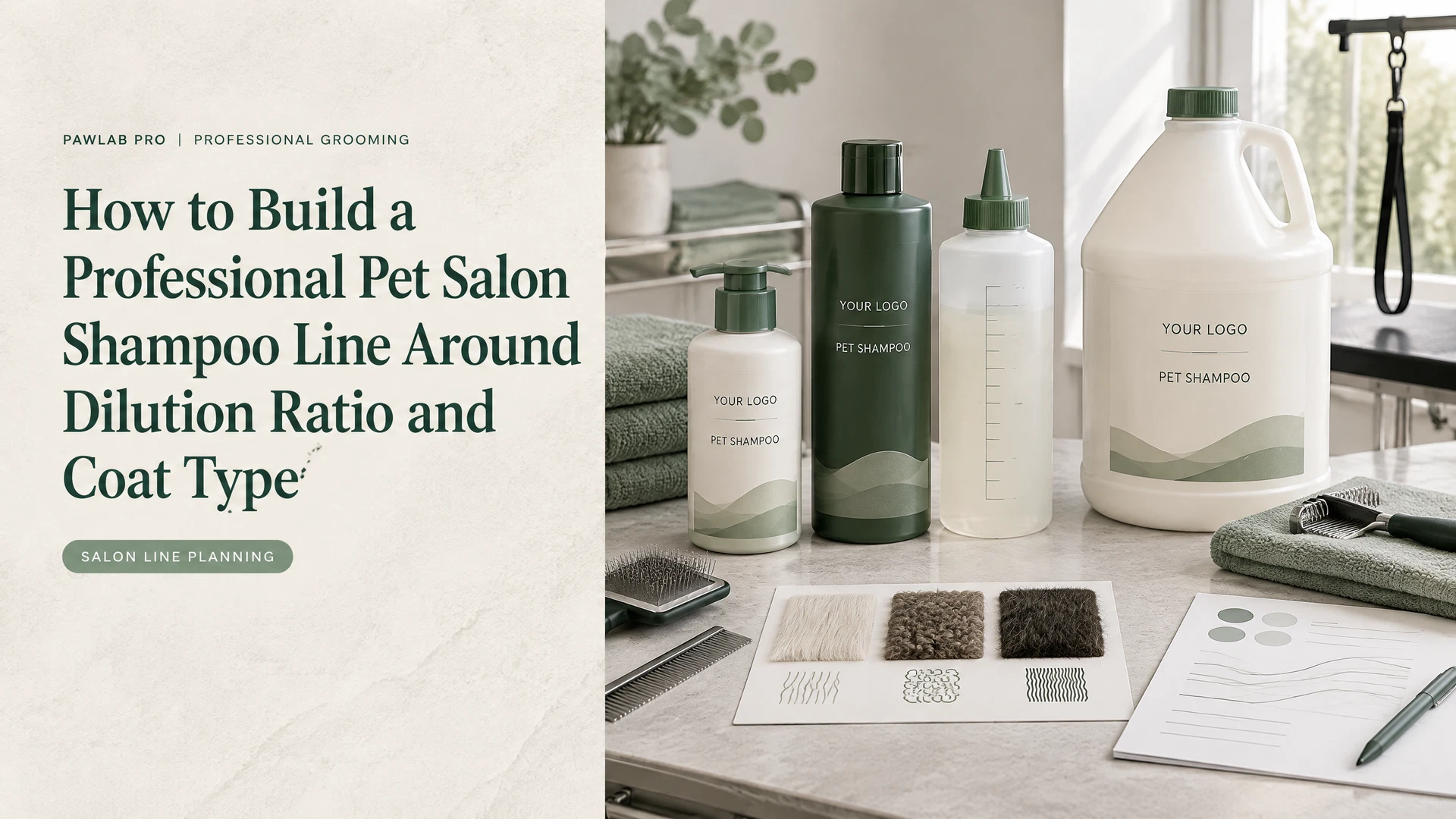
Start by mapping the salon routine, then decide what the client can realistically take home. Our professional pet salon shampoo line guide addresses how coat type and product-specific dilution routes can shape the professional side. This article adds the range-planning question: which retail SKU carries the routine forward without confusing the channel role?
2. Choose the Launch Architecture Before Requesting Samples
There are three practical ways to enter the salon market. A Backbar-led launch makes sense when the brand’s primary commercial proof point is professional service use. A retail-led launch can fit a retailer or e-commerce brand that wants salon credibility without operating a professional bulk program on day one. A coordinated pair can work when the team can approve, inventory and explain both roles at the same time. The choice is not a universal rule; it is a capacity decision involving quantities, sampling, packaging, artwork, inventory and the sales channel.
| Launch Route | When It Can Fit | First Approval Focus | Risk to Control |
|---|---|---|---|
| Backbar-led | The salon workflow is the first route to market and the team needs one clear professional anchor SKU | Service instructions, bulk pack, dispensing, sample route and professional label direction | Adding retail bottles before the core salon role is proven and clearly specified |
| Retail-led | The buyer has a retail or e-commerce route but wants a future salon-compatible product story | Retail pack, at-home directions, channel positioning and a future professional range boundary | Using salon language that the retail product cannot support in practice |
| Coordinated pair | The brand has the operational capacity to launch professional and take-home products as a connected routine | Role distinction, formula/pack relationship, samples, artwork and quantity assumptions for both SKUs | Approving one SKU while assuming the second will match without its own representative review |
Every additional SKU introduces another formula or product version, pack combination, artwork file, quantity commitment, sample path and reorder decision. That does not mean a broader line is wrong. It means a two- or three-SKU launch should have a clear commercial reason. Supplier guidance on initial product ranges similarly emphasizes distinct roles, channel fit, development workload and inventory capacity rather than an arbitrary SKU target. [1]
3. Create a Channel Handoff, Not a Duplicate Product Story
A useful salon-to-retail handoff gives the client a clear next step after the service. That may be a home-use shampoo with a compatible grooming story, a conditioner that has a distinct coat-care role, or a between-bath format selected for the retail routine. The handoff should not rely on a vague claim that the retail product “recreates the salon result.” Instead, define the shared features and the separate responsibilities.
For example, a Backbar cleansing product and a retail shampoo may share a general product family or scent direction while using different packs and directions. A retail conditioner can extend the routine if it has its own intended role. The correct decision is confirmed in finished samples and the final labeling process—not in a mood board or a supplier’s stock list.
| Shared Element | What the Brand Can Define | What Must Still Be Reviewed Separately |
|---|---|---|
| Range identity | Product family, visual hierarchy, restrained scent direction or coat-care system story | Whether each finished SKU’s formula, label and package support that identity |
| Grooming sequence | Which product is used in salon service and which is intended for take-home routine | Actual directions, dose or dilution information, storage and user-facing language |
| Coat-care architecture | How shampoo, conditioner and other formats avoid duplicate roles | Formula-specific evidence and the final public claims for each item |
| Brand visual system | Container family, label layout, color coding and retail shelf relationship | Artwork version, legal text, pack compatibility and the actual available component route |
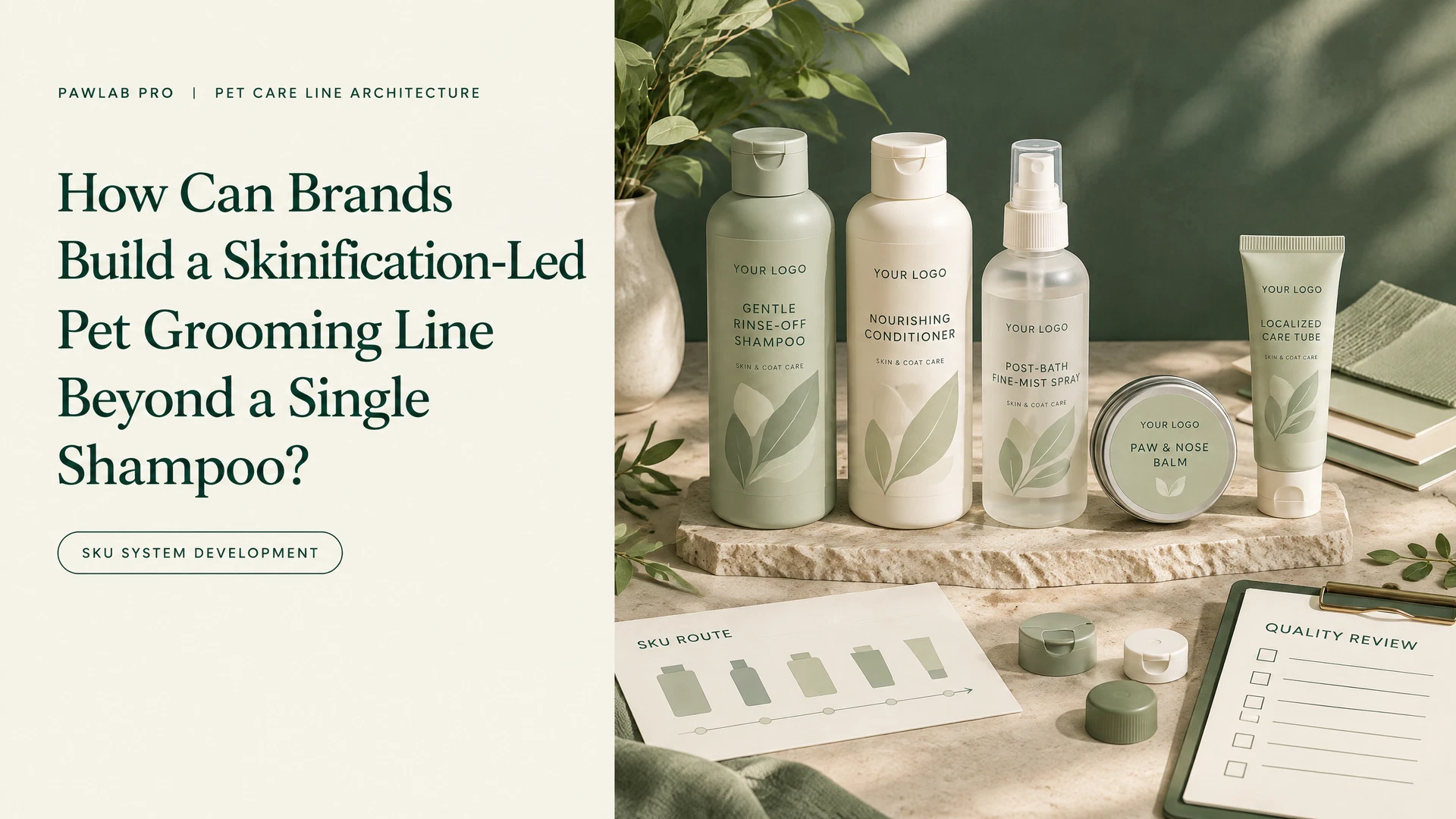
A companion conditioner is often the most direct way to create a second role, but it should be selected for its position in the routine rather than as an automatic add-on. See our pet conditioner and detangler OEM guide for the formulation, pack and claim boundaries that make a conditioner a distinct development project.
4. Match Formula and Pack to the Actual Channel Workflow
Professional and retail pack choices affect how the product is handled, evaluated and described. A salon bulk format may require a dispenser or dilution direction that fits the intended service workflow. A retail pack has to work for at-home handling and the target sales channel. The right commercial structure is not determined by a single pack format; it emerges when formula properties, dispensing, closure, leakage or seal review, artwork space, shipping and user experience are considered together.
Do not set a universal dilution ratio, size, pump output or cost saving in an early brief. Instead, specify the service workflow and ask the manufacturer which formats, samples and evidence are needed for the proposed formula. The same disciplined approach applies to a grooming salon shampoo wholesale discussion: a quoted pack is not a finished operational plan until the selected formula, package, instructions and sample are linked.
| Channel Decision | Backbar Review | Retail Review | Approval Record |
|---|---|---|---|
| Format | Ready-to-use or product-specific concentrate route under intended salon conditions | Ready-to-use at-home use and a clear package-specific direction | Approved formula version, pack and use direction for each SKU |
| Closure and dispensing | Pump, cap, dispensing accessory or bulk-handling path | Consumer handling, closure fit, shelf presentation and shipping route | Representative samples and package-compatibility observations |
| Range packaging | Professional identification and storage approach | Retail hierarchy, size and product differentiation | Artwork versions, coding and finalized component specification |
| Reorder planning | Bulk usage assumptions and stock-management responsibility | Retail replenishment, retailer or distributor ordering needs and stored-material terms | Commercial scope, quantity basis and change-control owner |
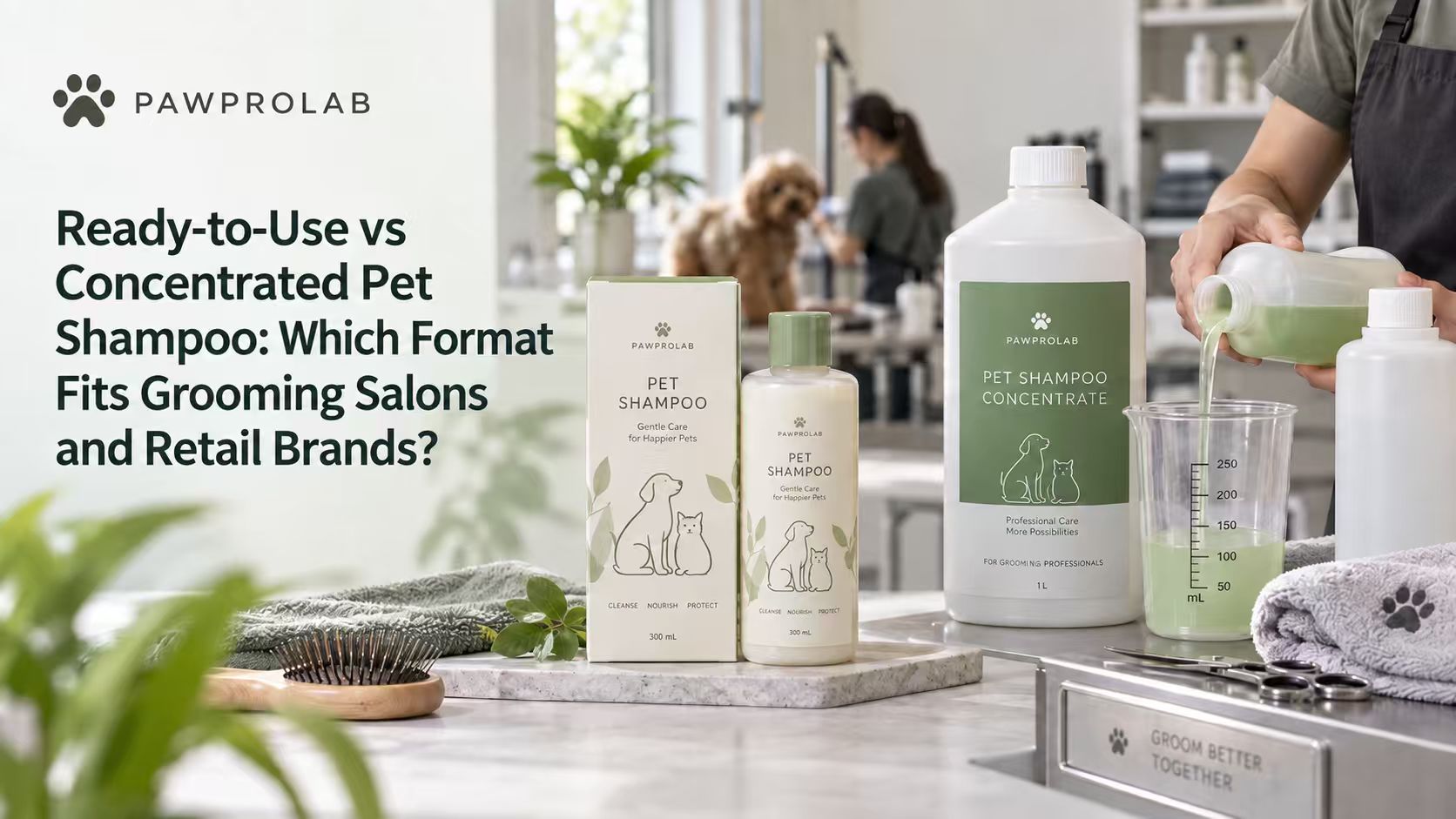
For the pack-format decision itself, use our professional pet shampoo packaging guide. For the commercial choice between a ready-to-use retail direction and a salon concentrate route, use our ready-to-use versus concentrated guide. Those pages explain the individual trade-offs; this page connects them to a salon-plus-retail assortment plan.
5. Approve Backbar and Retail Samples as a Connected System
A small salon assortment should have a single approval map, even when each SKU has a separate sample. Record the formula version, package version, artwork status, intended channel, user instructions, target market and open decision for each item. A good salon sample is useful evidence, but it does not prove that the retail package, bulk component, label copy or production batch can be approved without their own review.
Supplier-selection guidance cited here treats formula, packaging and sampling as a connected workflow. [2] At minimum, the brand needs a record of which sample represents which final direction, which component is still provisional and what changes would trigger a new review. That control avoids the familiar failure mode in which a buyer approves a pleasant laboratory sample but later discovers that the package, instructions or channel role has changed.
| Approval Gate | Backbar Question | Retail Question | Decision Owner |
|---|---|---|---|
| Formula identity | Does the product version fit the intended professional service role? | Does the product version fit the at-home routine and retail positioning? | Brand product lead with supplier technical team |
| Use and pack review | Does the selected pack support the proposed handling and service directions? | Does the pack support the intended retail handling and shelf route? | Brand operations lead with packaging contact |
| Range coherence | Does the professional SKU have a clear service role? | Does the take-home SKU continue the routine without duplicating the Backbar item? | Brand category or channel lead |
| Copy control | Are directions and professional descriptors limited to the approved finished product? | Does retail copy avoid treatment, universal-safety and unsupported performance language? | Brand market-review owner |
The production parameters for a shampoo should also be controlled separately from product-line messaging. Our pet shampoo pH, viscosity, foam and rinseability guide explains how to turn formula behavior into a written production review. A retail or salon pack does not eliminate that formula-level approval work.
6. Build the Manufacturer Brief Around the Channel Decision
A useful brief makes the supplier’s response comparable. Do not ask for “a professional salon line” and then compare quotations built on different assumptions. State which channel comes first, what the proposed roles are, what is known and what is still open. A manufacturer can then identify which questions affect formula customization, packaging availability, quantity, timing, samples, documents and commercial terms.
| Brief Input | What to Specify | Why It Matters |
|---|---|---|
| Channel architecture | Backbar-led, retail-led or coordinated-pair launch; professional and retail roles | Gives the factory one commercial structure rather than an unranked list of items |
| Product and coat-care scope | Proposed shampoo, conditioner or other SKU roles; target animal and intended grooming use | Helps prevent unnecessary product overlap and unapproved claim language |
| Format and package direction | Ready-to-use or concentrate route, anticipated bulk/retail sizes, closures and component constraints | Allows formula, dispensing and component questions to be scoped together |
| Commercial starting point | Target market, estimated quantity by SKU, target launch window and known distribution route | Clarifies which commercial variables remain conditional rather than assumed |
| Approval and documentation needs | Sample rounds, intended copy review, requested records, decision owner and change-control trigger | Creates a traceable path from first sample to production release |
The initial choice can begin with an existing product direction but must end in a controlled project scope. For example, PawLab Pro’s Professional Volumizing Pet Shampoo can inform a category conversation; it does not pre-approve a customized formula, pack, claim or channel plan for another brand. Each final project requires its own confirmed sample and specification.
7. Keep Grooming Claims Within the Product’s Actual Scope
A professional channel does not justify stronger claims. For U.S.-facing projects, FDA guidance describes grooming aids as products intended solely to cleanse or beautify animals. [3] A salon or retail label should therefore be reviewed against the product’s intended use, target market, supporting evidence and the final approved wording.
For EU destination markets, treat the U.S. FDA framing as non-transferable: confirm the applicable market, product, chemical, label-language and claim requirements for each finished SKU through qualified local review before release.
Do not turn a coat-type direction, a scent concept, a pH target or a professional format into claims that a product treats disease, controls parasites, prevents allergies, kills microbes, works for every animal or produces guaranteed results. These are separate claim and market-review questions. The commercial value of a well-designed Backbar-and-retail line is clarity: each product has a role, each package has an intended workflow and each approved phrase has a traceable basis.
This article is not veterinary, medical, legal, market-authorization, antimicrobial, allergy-prevention, universal-suitability, treatment, parasite-control or guaranteed-performance advice. It is a B2B range-planning framework for a non-medicated grooming assortment.
FAQ: Private-Label Pet Grooming Products for Salons
Should a salon Backbar shampoo and retail shampoo use the same formula?
Not automatically. They may share a product family when the formula direction, package, use instructions and commercial role support that relationship. A bulk professional format and a retail bottle should each be evaluated as their own finished product and packaging system before approval.
What is the first SKU for a salon private-label line?
There is no universal first SKU. A Backbar-led launch can start with a defined professional anchor product; a retail-led launch can start with an at-home core product; a coordinated pair can be suitable when the buyer can manage both scopes. Choose the product with the clearest channel role and the most controlled development path.
How many retail take-home products should accompany a salon line?
Start with the smallest number that gives every item a distinct role. A shampoo and a companion conditioner may form a coherent routine, but adding products only to create a larger catalogue can add inventory, packaging and approval complexity without improving the buyer proposition.
Can a salon shampoo be marketed as suitable for all coat types?
Not without support for that specific finished product and market. A better development approach is to define the target coat-use direction, sample conditions and label language, then approve only what the final evidence and review process support.
What information should a salon brand send to an OEM before quotation?
Provide the target market, channel route, proposed product roles, format and package direction, estimated quantity per SKU, target launch timing, sample/review needs, requested documents and open decisions. This makes supplier quotations and development responses comparable.
Request a Salon Backbar-and-Retail Assortment Brief
PawLab Pro can help structure a B2B grooming project around your salon channel, retail handoff, proposed product roles, target market, package direction, expected quantity and sample approval route. The goal is not to create a larger assortment by default; it is to define the smallest coherent system that your brand can manufacture, present and reorder with control. Contact PawLab Pro to request a salon Backbar-and-retail assortment brief.
References
- Rixin Pet Care. How Many Pet Grooming Products Should a New Brand Launch?
- Rixin Pet Care. How to Choose a Private Label Pet Grooming Manufacturer.
- U.S. Food and Drug Administration. CPG Sec. 653.100 Animal Grooming Aids.