Pet-care OEM insights
Professional Pet Shampoo Packaging: Retail Bottle vs Refill Pouch vs Gallon Jug
Compare retail bottles, refill pouches and gallon jugs for professional pet shampoo, covering salon dispensing, freight, refill workflows and sample approval.
TAKEAWAYS
- Choose a retail bottle when the priority is a controlled, consumer-facing unit with simple direct-use directions; choose a pet shampoo refill pouch when the program can support a defined transfer workflow; choose a gallon dog shampoo route when professional backbar handling, storage and repeatable dispensing are part of the brief.
- Do not compare formats through unit volume alone. The decision must include channel, closure or fitment, formula flow, handling weight, transport configuration, transfer method, label space and the buyer’s actual operational cost model.
- Packaging is not a separate artwork decision. Bottle, pouch and gallon jug should be validated with the finished formula, selected closure, directions and expected shipment or handling routine.
- For grooming salons, a gallon can support a controlled professional workflow only when decanting, pump or pour practice, traceability and staff directions are defined. It does not automatically create a lower cost per groom.
- Keep grooming-aid claims tied to cleansing and beautifying. The chosen package does not prove treatment, safety, leak-free transit, sustainability or performance for every animal.
1. Choose the Commercial Route Before Choosing the Container
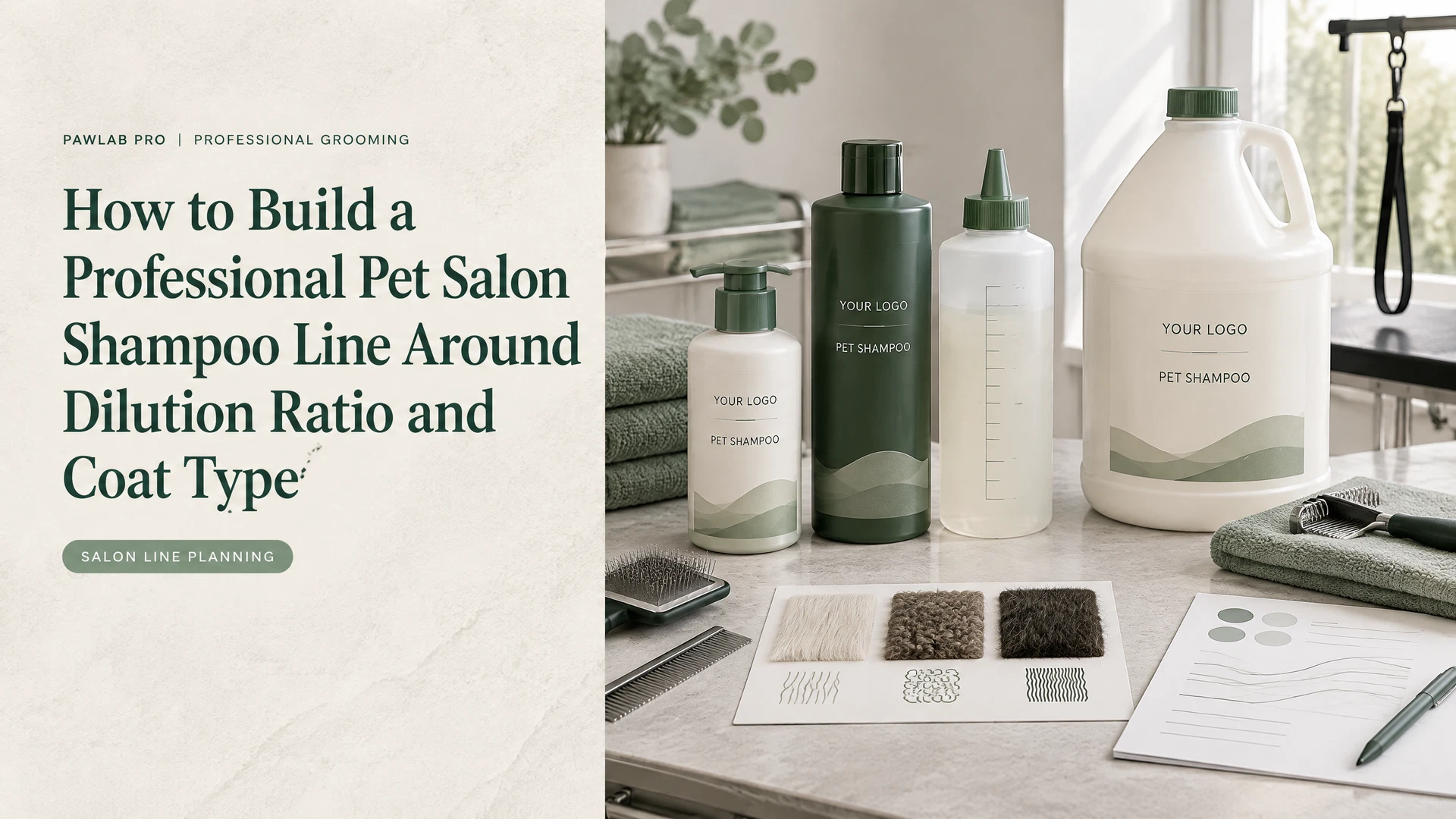
Professional grooming shampoo packaging should start with the route to market rather than a visual preference. A retail bottle is usually a finished consumer unit. A refill pouch is a replenishment component that must transfer into a defined receiving bottle or dispenser. A gallon jug is typically a backbar or bulk-handling format for grooming salons, mobile groomers, distributors or controlled replenishment programs. Each route changes who handles the liquid, how they dispense it, which instructions are necessary and what a sample approval must prove.
For procurement briefs and supplier searches, use the exact term professional grooming shampoo packaging when the request covers the finished liquid, dispensing route and professional channel—not just an empty container or an artwork concept.
For routine pet bathing products intended solely to cleanse or beautify animals, FDA describes the category as animal grooming aids. That framing does not support therapeutic, disease, allergy or antimicrobial promises. This article therefore focuses on operational packaging decisions: dispensing, transport planning, transfer and claims review. [1]
| Format | Most Natural Channel | Primary Operational Question | What Must Be Approved |
|---|---|---|---|
| Retail bottle | E-commerce, specialty retail, first-purchase consumer units | Can the end user dose and use the shampoo directly from the selected closure? | Formula, bottle, closure, label copy, case configuration and shipping check |
| Refill pouch | Replenishment programs, retail refills and repeat-purchase systems | Can the user identify, open and transfer the liquid into the intended receiving pack without improvised handling? | Formula, pouch structure, spout or fitment, seal, transfer directions and code placement |
| Gallon jug | Grooming salons, professional backbar, distributor and bulk routes | Can the team carry, store, dispense or decant the product in a repeatable professional workflow? | Formula, jug, handle, closure or pump, operating direction, traceability and transit plan |
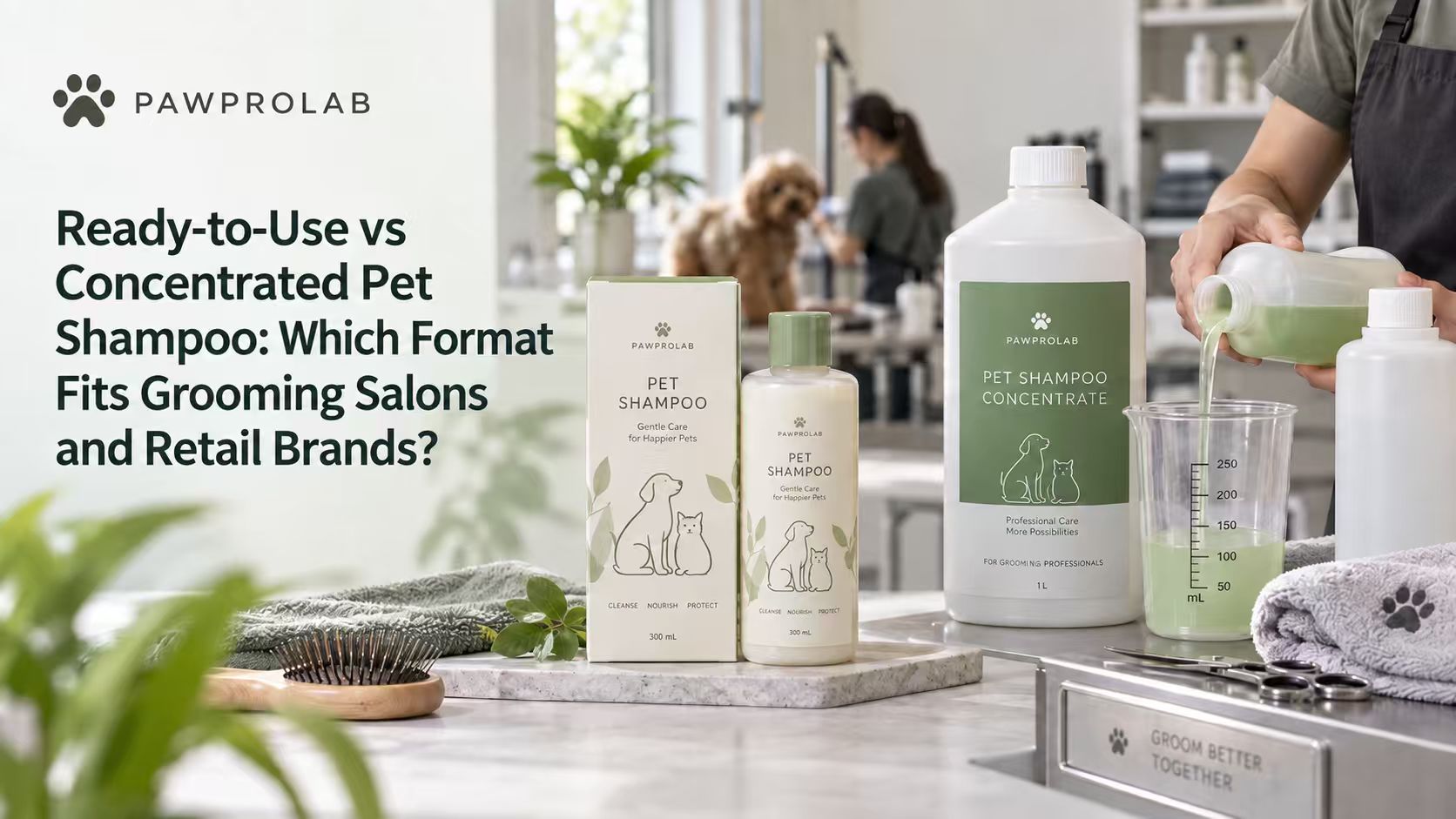
A useful launch brief names one primary route, rather than assuming that a single pack can equally serve every channel. Brands that are also weighing concentration and direct-use systems can pair this comparison with our ready-to-use versus concentrated pet shampoo guide. That decision changes the package’s dispensing and directions requirements before the bottle, pouch or jug is chosen.
2. When a Retail Bottle Is the Better Private-Label Starting Point
A retail bottle is often the clearest format for a new consumer-facing SKU because it combines the product, direct-use routine, label and closure in one unit. It can be right for brands that need shelf-ready presentation, a defined purchase unit and a simple rinse-off process. The bottle is not automatically the right choice for every formula or sales channel, however. Its volume, shoulder shape, closure, label panel, case pack and shipping profile must be matched to the approved liquid and buyer brief.
| Retail Bottle Decision | Why the Buyer Should Care | Sample Review Prompt | Do Not Assume |
|---|---|---|---|
| Closure choice | Shapes direct dosing, opening and wet-hand use | Does the cap, disc top, flip top or pump provide the intended amount with the finished formula? | One closure type suits every viscosity or route |
| Retail volume | Connects price point, consumer routine, shelf plan and replenishment | Does the selected fill volume fit the launch brief and case plan? | A larger bottle is always a better value proposition |
| Label panel | Must carry identity, directions, ingredient and target-market content as applicable | Is the approved copy readable on the actual filled container and compliant for the target market? | Artwork can be finalized without formula or closure approval |
| Transit configuration | Links primary pack to case, pallet and customer delivery conditions | Have filled units and selected closures been reviewed in the intended shipment configuration? | A bottle that looks stable when empty will perform identically when filled |
The retail route should retain its own sample record: formula code, fill volume, selected bottle, closure, label revision, case configuration and observed handling result. The required standard is not a claim that the bottle can never leak; it is evidence that the product-and-pack combination has passed the project’s agreed approval steps.
3. What a Pet Shampoo Refill Pouch Must Solve Beyond “Less Packaging”
A pet shampoo refill pouch is a system component, not just a lower-profile version of a bottle. The buyer must define what it refills, who does the transfer, whether the receiving container is cleaned or replaced, how the user recognizes the correct product and how the spout or opening controls flow. A pouch can fit a replenishment strategy when these operations are clear. It should not be chosen solely because it supports a broad environmental message.
For liquid pouches, material compatibility is a core validation issue. ZACROS notes that the wrong packaging material can damage a liquid product and emphasizes the need to work with suppliers that understand liquid chemical compatibility. That is why the formula, laminate, fitment and seal should be reviewed together with the actual shampoo, not approved from a pouch rendering alone. [2]
| Refill-Pouch Control | What to Define Before Sampling | What to Observe | Release Evidence |
|---|---|---|---|
| Receiving pack | The compatible bottle, dispenser or salon vessel the pouch is designed to replenish | Whether the receiving pack and transfer procedure are unmistakable | Approved system brief and directions |
| Spout or fitment | Opening style, cap, product flow and intended pouring angle | Pour control, drips, handling comfort and closure reseal behavior | Selected fitment specification and handling notes |
| Pouch structure | Material structure, fill volume, seal design and formula compatibility plan | Appearance, seal integrity and product interaction after the agreed review conditions | Compatibility and package-validation record |
| Traceability | Location of lot or date information and connection to the receiving product system | Visibility and readability after filling and handling | Approved code-placement artwork |
Do not call a pouch more sustainable, easier to ship or lower cost without a defined material, freight, destination and operating comparison. A more credible private-label brief documents what is being compared and what still needs validation. For a detailed packaging-stage review, see our pre-launch OEM packaging validation checklist.
4. How a Gallon Dog Shampoo Route Changes Professional Handling
A gallon dog shampoo route may fit grooming salons, mobile groomers and professional users that manage backbar inventory. Its commercial value comes from a controlled high-volume workflow, not from the jug alone. The launch brief should specify whether the product is ready to use or concentrated, who lifts and opens the container, whether a pump or pour accessory is selected, whether the shampoo is decanted and which directions apply after transfer.
This is also where a bulk dog shampoo manufacturer should require precision from the buyer. “Bulk” cannot replace a usable operating specification. The manufacturer needs the intended fill size, formula behavior, closure or dispenser, storage situation, case and pallet plan, destination market, label content and sample acceptance criteria. A gallon container that works in one salon workflow may be a poor fit for a mobile kit or a retail customer who has no controlled dispensing setup.
| Gallon-Route Decision | Professional Workflow Question | Approval Check | Commercial Risk if Undefined |
|---|---|---|---|
| Ready-to-use or concentrate | Will salon staff use the product directly or prepare a defined dilution? | Review formula direction, label instructions and selected measuring or mixing tool together | Inconsistent service workflow and unclear staff directions |
| Jug handling | How will staff carry, open, pour or mount the container? | Assess handle, closure, operating position and actual filled-pack handling | Uncontrolled transfer, product loss or difficult backbar use |
| Dispensing accessory | Does the salon need a pump, meter, decant bottle or a specified pour method? | Use the selected accessory with the finished formula and documented process | Assumed dose and unreliable cost-per-service calculations |
| Bulk transport plan | Which case, pallet and storage conditions are part of the actual route? | Review the filled container within the intended shipping and storage plan | Packaging selected without an operational distribution plan |
Brands developing a professional liquid route should also define the shampoo’s flow, foam and rinse behavior in the selected pack. Our pet shampoo pH, viscosity, foam and rinseability guide explains how those release criteria connect formula approval to pack performance without pretending that one target or coat observation applies to every product.
5. Model Cost, Transport and Replenishment Without Making Invented Savings Claims
A defensible packaging choice separates verified inputs from assumptions. Retail buyers may compare unit purchase, case count and customer-delivery configuration. Salon buyers may compare purchased product, approved service dose, dispensing accessory, staff handling, prepared-batch practice and product loss. Refill buyers may compare receiving-pack retention, pouch fill, transfer process and inventory cadence. None of these models should be published as a universal cost saving without the buyer’s actual product, freight, pricing and operational data.
| Model Component | Retail Bottle | Refill Pouch | Gallon Jug |
|---|---|---|---|
| Purchased unit | Finished shelf-ready bottle | Pouch plus defined receiving-pack system | Bulk container plus selected dispensing or transfer method |
| Use measurement | Direct dose per wash routine | Volume transferred and direct dose from receiving pack | Direct dose or formula-specific prepared-batch use |
| Transport review | Unit, case and retail delivery configuration | Pouch, fitment and receiving-pack workflow | Filled jug, case/pallet plan and professional handling condition |
| Cost control prompt | What does the approved unit and delivery route cost in the target channel? | What does the approved pouch-to-receiving-pack system cost to run? | What does the approved product-plus-dispensing workflow cost per documented service? |
The commercial team should use its own verified inputs to model purchase and operating cost. The product-development team should separately document what the package has been shown to do under agreed sample conditions. Combining the two disciplines is more useful than a generic claim that a large pack is always cheaper or that a pouch automatically reduces shipping cost.
6. Use One Packaging-Approval Scorecard Across the Chosen Route
Whether the product will launch in a bottle, pouch or gallon jug, the sample review should connect formula, pack and channel. Send reviewers a coded finished sample rather than an empty component. Record the product version, selected package, fill, closure or fitment, storage reference, transfer or dispensing method, directions, shipment scenario and approval result. This turns package selection into a controlled commercial decision.
| Scorecard Field | What to Record | Decision Use |
|---|---|---|
| Formula and fill | Formula code, fill volume and selected manufacturing sample | Prevents an approval from being detached from the actual product version |
| Primary pack | Bottle, pouch or jug specification plus closure, pump or fitment | Confirms the sample matches the intended launch route |
| Operating sequence | Direct dose, refill transfer, decanting or dilution steps as applicable | Tests the real channel workflow rather than a generic laboratory handling action |
| Observed result | Controlled dispensing, pour behavior, closure use, label readability and agreed handling observations | Creates an approval record without turning one observation into a universal guarantee |
| Release decision | Approved, revise, retest or hold, with reviewer and date | Links package development to production authorization |
Use our pet care formula sample evaluation guide alongside this scorecard when the formula and package are still being selected. The final product, directions, target-market label language and production specifications should be reviewed as one grooming-aid program. This article is not a universal transport, medical, safety, sustainability or performance guarantee.
FAQ: Professional Pet Shampoo Packaging
Is a gallon jug always best for professional grooming salons?
No. A gallon route can fit a salon that has a controlled storage, dispensing or decanting workflow, but it is not automatically the best option for every professional user. The product format, handling weight, closure, dispenser, service process and target channel should be reviewed together.
How should a brand choose between a refill pouch and a retail bottle?
Start with the end-user workflow. A retail bottle is a direct-use unit; a pouch needs a defined receiving pack and transfer method. Then validate the finished liquid in the selected material, closure or fitment, label and shipment configuration. Do not choose on appearance or sustainability language alone.
Can a refill pouch use the same formula as a bottle?
Possibly, but the brand should not assume the materials, seals, spout, transfer process and storage behavior are interchangeable. Review the finished formula with the actual pouch structure and fitment as part of sample approval.
What should a bulk dog shampoo manufacturer need before quoting a gallon program?
At minimum, the intended formula direction, fill size, product behavior, closure or dispensing method, channel, label requirements, case and pallet plan, target market and sample acceptance criteria. A professional bulk program requires an operating brief, not only a volume request.
Build the Package Around the Actual Channel
PawLab Pro helps B2B buyers convert a retail, refill or salon-backbar concept into a controlled OEM/ODM sample brief covering formula behavior, selected packaging, transfer or dispensing method, label review and production approval. Contact our team to discuss a private label pet shampoo packaging route for your professional or retail program.
References
- U.S. Food and Drug Administration. CPG Sec. 653.100 Animal Grooming Aids. Updated March 1, 2019.
- ZACROS America. Basics of Refill Pouches. Accessed September 12, 2026.