Pet-care OEM insights
Pet Shampoo Refill Systems for Retail and Grooming Salons: Concentrate, Refill Pouch, or Bulk Backbar?
Compare pet shampoo refill systems for retail and salons: refill pouches, concentrates and bulk Backbar routes, with labeling, samples and control questions.
A pet shampoo refill system should be approved as a controlled source-to-use handoff, not as a pouch, concentrate or bulk container selected in isolation. The brand needs one record that identifies the source SKU, the receiving pack or preparation vessel, the handler, the product-specific directions, the information that follows the product, the linked sample and the changes that trigger review before the next order.
This B2B framework is for private-label brands, distributors, retailers and grooming-salon buyers planning non-medicated shampoo replenishment. It covers retail refill, salon concentration and bulk Backbar only where each route changes the control record. It does not replace existing PawLab Pro articles on choosing a package, choosing direct-use versus concentrate, designing a salon range or completing general packaging validation. It does not prescribe a universal ratio, pack size, transfer process, cost outcome, environmental outcome, label template, product performance or suitability.
TAKEAWAYS
- Create one Refill System Control Record before approving components: source SKU, source/receiving components, handler and directions, traceability, linked sample, reorder terms, owners and change triggers.
- Use the record to distinguish retail refill, salon concentrate and bulk Backbar routes. They may share a brand family, but they do not automatically share a product, receiving unit, directions or claim scope.
- Release a first order only after a representative source-to-use sample set is reviewed. A liquid sample, empty pouch or empty bulk pack alone is not a refill-system approval.
- Use an explicit reorder rule: no change can follow controlled release; a document-only change, representative-sample change or market/claim change each needs a different review path.
- Keep U.S. source material and EU destination-market review separate. A supplier’s project support does not equal a market decision for the finished product and label.
1. Make the Refill System Control Record the Primary Deliverable
A pet shampoo refill system is not a single component. It is the controlled relationship between a source product and the point at which that product is used, transferred or prepared. The record below gives the buyer a reusable way to keep that relationship visible from initial sampling through reorder.
For a private label pet shampoo refill project, the first useful supplier conversation is therefore not “Which refill pack is cheapest?” It is “What exact source-to-use route are we asking to control?” A supplier may have valid input on formula, component or filling scope, but the brand should assign and document the final owner for each decision.
| Control-Record Field | What the Buyer Should State or Request | Why the Field Exists |
|---|---|---|
| Source SKU | Product name, formula/version identifier, product role, selected source fill and target market | Stops a generic “shampoo refill” from standing in for a defined finished product |
| Source and receiving components | Source container/fitment plus named receiving bottle, dispenser or preparation vessel | Connects the product to the exact transfer or preparation point |
| Handler and directions | Consumer, retail team, salon team or distributor; approved product-specific handoff instructions | Makes the operating assumption visible before it becomes a label or training problem |
| Traceability and information | Product identity, formula/pack version, lot/date route, direction location and responsible-party information as applicable | Preserves the connection between replenishment activity and the identified SKU |
| Linked sample | Source product, relevant components, intended directions, current artwork/status and named reviewer | Prevents approval of one element from being mistaken for approval of the system |
| Reorder terms and owners | Quantity basis, component/print assumptions, stored materials, document owner and escalation owner | Makes a repeat order comparable to the approved first order |
| Change triggers | Formula, fragrance, source/receiving component, artwork, market, instruction, quantity or claim changes | Defines when the next order must pause for controlled review |
This article owns the record and its release decisions. For the physical package comparison, use our professional pet shampoo packaging guide. For channel-role planning, see our Backbar-and-retail assortment guide. Those articles answer different questions and should be used as inputs to this control record rather than duplicated here.
2. Put Each Route Into the Same Record, Without Treating Them as Interchangeable
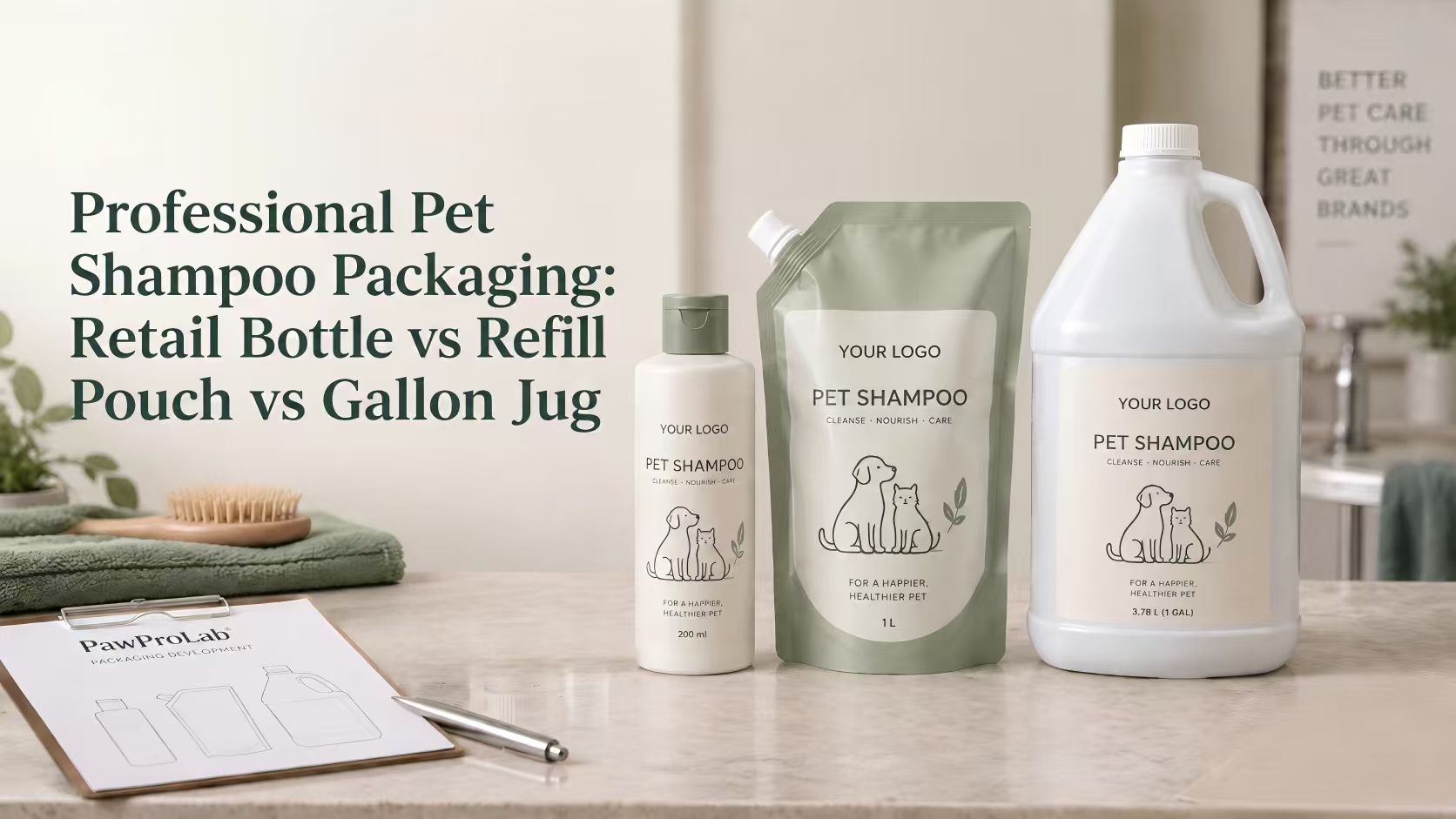
The three routes in the title differ because the handoff is different. A retail-ready refill is intended to replenish a named direct-use unit. A salon concentrate is a source product that enters a product-specific preparation workflow. A bulk Backbar unit supports a professional inventory and dispensing routine. The control record makes those differences testable without re-running a generic pack-format comparison.
| Route in the Control Record | Source-to-Use Boundary | Minimum Distinct Fields | Boundary to Preserve |
|---|---|---|---|
| Retail ready-to-use refill | Named refill source → specified consumer-facing receiving pack | Receiving-pack ID, transfer directions, retail information continuity and current pack artwork | Do not assume a similar bottle, cap or capacity is an approved recipient |
| Salon concentrate | Source concentrate → named measure/preparation vessel → prepared product holder | Product-specific direction, measure, preparation vessel, prepared-batch identification and salon owner | Do not treat a professional concentrate as a consumer refill by default |
| Bulk Backbar | Bulk source SKU → selected professional dispenser/transfer route | Inventory holder, dispenser/transfer component, staff-facing identity information and reorder owner | Do not treat bulk supply as a complete specification merely because the fill volume is larger |
A refill pouch dog shampoo route should therefore identify the actual receiving retail unit and the information that remains available after replenishment. An concentrated dog shampoo wholesale route should identify the product-specific preparation and professional holder. A bulk dog shampoo for groomers route should identify the inventory, dispenser and team owner. These are different record entries even if the same brand has approved all three formats.
The direct-use versus concentrate question is addressed in our ready-to-use versus concentrated pet shampoo guide. The present question is narrower: once a route is chosen, can the next source-to-use handoff be reproduced from a controlled record?
3. Release the First Order Through a Linked Source-to-Use Sample Set
The first release should prove the system actually being bought, not only its separate parts. A liquid sample may be useful for formula direction. An empty component may be useful for sourcing. Neither shows how the approved source product, receiving/preparation route and information set work together.
| Required Sample-Set Item | Retail Refill Example | Concentrate Example | Bulk Backbar Example |
|---|---|---|---|
| Identified source | Filled refill source with formula/version and current source-pack status | Source concentrate with the applicable product-specific direction | Bulk source SKU with selected fill and current pack status |
| Use-side component | Specified receiving bottle/dispenser | Named measure, preparation vessel and prepared-product holder | Selected dispenser or transfer component used by the professional team |
| Instruction and identity | Current transfer direction plus product/code information route | Current preparation direction and prepared-batch identification approach | Current staff-facing identity and handling direction |
| Reviewer decision | Record approved, conditional or unresolved elements | Record approved, conditional or unresolved elements | Record approved, conditional or unresolved elements |
Formula performance criteria remain outside this control record; use our pet shampoo pH, viscosity, foam and rinseability guide to define the product-specific formula review that the linked source-to-use sample must reference.
Industry flexible-packaging examples illustrate that source packs can involve distinct fitment, capacity and structure decisions. [4] That does not prove the suitability, durability, environmental outcome or commercial terms of a particular pouch. The linked sample set is where those project-specific questions remain controlled rather than assumed.
Use our pre-launch OEM packaging validation checklist for the broader packaging review. The control record adds the specific condition that the source-to-use linkage must be reviewed as a system.
4. Apply a Reorder-Release Rule Before Calling the Next Order “the Same”
A reorder is only a no-change repeat when every controlled input remains within the approved record. The buyer should decide which inputs trigger which review before issuing the first purchase order. This prevents a formula, component, artwork, market or commercial change from being handled informally under a prior approval.
| Observed Change State | Examples | Release Decision | Record Output |
|---|---|---|---|
| No controlled change | Same approved source SKU, components, artwork/version, market, instructions, quantity basis and owners | Proceed under the approved control record, subject to the agreed order checks | Reference the prior release, current quotation/PO and current production identifiers |
| Document update | Clarified owner, corrected non-substantive contact detail, revised record formatting, or a quantity-basis/stored-material update that does not alter source SKU, component/print configuration, directions, market or claims | Update and approve the record before release; confirm no sample, label, market or claim input changed. Any component, print, fitment or source-to-use substitution moves the order to representative-sample review. | Versioned control record and named document approver |
| Representative-sample review | Formula/fragrance change, source or receiving component change, fitment change, artwork that affects directions/code placement, new dispenser or altered transfer path | Pause the reorder for project-specific sample and component review before release | New sample ID, scope, reviewers, decision and open-condition log |
| Market or claim review | New destination market, new language/label context, changed intended use, changed environmental statement or new product claim | Pause for the applicable qualified market, label and claim review before reusing the prior release | Target-market decision record and updated approved scope |
The rule is intentionally conservative without claiming that every change has one universal legal or technical consequence. It tells the project team which changes must be visible. The specific finished product, destination market, component and claim determine the appropriate review.
5. Assign Owners Before the First Refill Program Launches
Supplier support can be valuable, but a refill system fails when critical handoffs have no named owner. The Control Record should state who supplies an input, who decides it, who stores the latest version and who is notified when a change occurs. The roles below are a buyer-side project template, not a representation of every manufacturing arrangement.
| Control Area | Typical Buyer-Side Owner | Typical Supplier/Partner Input | Escalation Trigger |
|---|---|---|---|
| Product and channel brief | Brand product lead or procurement owner | Feasibility questions and documented assumptions | Format, formula, channel or estimated-quantity change |
| Source/receiving component pairing | Packaging/project owner | Component specification, sample path and scoped compatibility input | Source pack, recipient, fitment or dispensing route change |
| Directions and information route | Brand label/market owner | Current product and pack facts that support the draft | Direction, code placement, artwork, market or claim change |
| Sample and release record | Named approver for the product launch | Sample identification, supplied configuration and unresolved-condition list | Any sample divergence from the selected source-to-use route |
| Reorder scope | Commercial/procurement owner | Current quotation assumptions, component/print status and lead conditions | Quantity, stored material, commercial term or ownership change |
For an OEM/ODM handoff that includes a formula, package, sample and commercial comparison, pair the record with our manufacturer-selection guide. It explains why a quote is not comparable until the buyer has defined which items are confirmed, conditional, buyer-supplied or still open.
6. Use a Non-Prescriptive EU Destination-Market Handoff
U.S. sources can help a buyer ask better questions, but they do not establish an EU launch route. For EU destination markets, U.S. FDA, APPA and FTC materials are not a substitute for qualified local review of the finished SKU, final label language and intended claims. The record should create a clean handoff for qualified local review of the actual finished product, its final label language and its intended market. This is a project-management table, not a statement of EU legal requirements or a substitute for qualified advice.
| Handoff Input | What the Control Record Should Provide | Why It Should Not Be Left Implicit |
|---|---|---|
| Finished product identity | Formula/version, intended grooming role, source and receiving component details | Market review cannot begin from a generic “refill shampoo” description |
| Target-market presentation | Destination countries, draft label languages, proposed responsible-party route and retailer/salon role | Market assumptions can change the information and review questions |
| Directions and replenishment process | Who handles the source product, what receives it, and draft final-use instructions | A refill concept may change what the user sees and does with the product |
| Claim and environmental language | Exact proposed wording, channel placement, evidence request and known qualifications | Broad terms should not be carried forward as implied outcomes |
| Open decisions | Unapproved formula, component, artwork, information or commercial inputs | Lets the reviewer distinguish final inputs from pending project choices |
7. Keep Claims Separate from Refill Design
For U.S.-facing projects, FDA’s nonbinding guidance describes products intended solely to cleanse or beautify animals as grooming aids, while claims, formulation, labeling and promotional materials can show a different intended use. [1] A refill route does not create a basis for therapeutic, antimicrobial, parasite-control, allergy-prevention or universal-safety language.
APPA’s labeling discussion highlights identity, responsible-party and net-quantity as areas that can matter for U.S. consumer packages. [2] The record therefore preserves information continuity; it does not provide a universal refill-label template. Likewise, the FTC Green Guides explain that environmental marketing claims should be truthful and substantiated and may need qualification to avoid deception. [3] A pouch, concentrate or larger pack does not automatically prove a lower cost, reduced waste, recycling result or other environmental outcome.
This article is not veterinary, medical, legal, market-authorization, antimicrobial, allergy-prevention, universal-suitability, treatment, parasite-control, certification, environmental-claim, or guaranteed-performance advice. It is a B2B control-record framework for a non-medicated grooming project.
FAQ: Private-Label Pet Shampoo Refill Systems
What is the first document needed for a private-label pet shampoo refill?
Begin with a Refill System Control Record. It should identify the source SKU, source and receiving/preparation components, handler, product-specific directions, traceability route, linked sample, owners, reorder terms and change triggers. This makes the first quote and sample request comparable without presuming a universal format.
Is concentrated dog shampoo wholesale the same as a consumer refill?
No. A concentrate can be a professional preparation input with product-specific measuring and mixing directions. A consumer refill has a different receiving-pack and information-continuity workflow. The control record should keep the two routes separate even when they share a brand family.
What does bulk dog shampoo for groomers need beyond a larger container?
Record the identified source SKU, professional inventory holder, selected dispenser or transfer component, staff-facing information, sample configuration, quantity basis and the changes that will trigger re-review. “Bulk” alone is not a complete handoff specification.
When should a reorder receive a new sample review?
Pause for a representative-sample review when a formula or fragrance, source/receiving component, fitment, artwork affecting directions or code placement, dispenser, transfer route or another controlled source-to-use input changes. The final review scope depends on the specific project and market.
Can a refill route be described as sustainable by default?
No. Environmental wording should state the exact claim, the element or operation covered, the comparison baseline and the required substantiation or qualification. A refill concept on its own does not establish a broad environmental outcome.
Request a Pet Shampoo Refill System Control Record
PawLab Pro can help organize a retail or professional replenishment project around its source SKU, receiving or preparation point, channel owner, product-specific directions, sample route, quantity basis, target market and change-control questions. The aim is not to force every brand into a pouch, concentrate or bulk format; it is to create a repeatable source-to-use record for the route you choose. Contact PawLab Pro to request a private-label pet shampoo refill system brief.
References
- U.S. Food and Drug Administration. CPG Sec. 653.100 Animal Grooming Aids.
- American Pet Products Association. Pet Product Labeling Requirements.
- Federal Trade Commission. Green Guides, 16 CFR Part 260.
- Anacotte Packaging. Pet Shampoo Refill Spout Pouch.