Pet-care OEM insights
How to Choose a Private-Label Pet Grooming Manufacturer for a Shampoo, Spray, Foam, or Wipe Project
Learn how to compare a private label pet grooming manufacturer for shampoo, spray, foam or wipe projects through scope, samples, packaging and change control.
A private label dog shampoo manufacturer—or any private label pet grooming manufacturer—should be selected for the exact project, not for the broadest catalogue, the shortest unqualified quote or a generic claim that it can make “pet care.” A shampoo, spray, foam and wipe each create a different connection between formula behavior, dispensing or substrate, packaging, sample review, label scope and commercial terms. The buyer’s first job is to define that connection well enough that every candidate supplier receives the same brief.
This guide is for B2B brands, importers, distributors, retailers and salon groups planning non-medicated grooming products. It helps a team compare project fit, evidence, sample control and responsibilities before production preparation. It does not prescribe a universal MOQ, lead time, test plan, product claim, safety outcome, market authorization or supplier ranking. The final formula, packaging, label wording, target market and evidence route must be reviewed for each finished SKU.
TAKEAWAYS
- Choose a manufacturer after defining the target market, product format, intended grooming use, package route, quantity basis, sample process and open decisions—not before.
- Use pass/fail gates before a scorecard. A low price or a large product list cannot repair a project-critical gap in format capability, sample control, package fit or responsibility.
- Ask different questions for shampoo, spray, foam and wipe projects. A format name alone does not confirm that the supplier can coordinate the relevant formula and packaging system.
- Review formula, packaging, samples, artwork and change control as one chain. A pleasant bench sample is not by itself approval of a production-ready finished product.
- Compare quotations only after every candidate has received the same scope, including what is included, excluded, assumed, buyer-supplied or still pending.
1. Start With a Comparable Project Brief
The first screening document should make suppliers comparable. A private label pet grooming manufacturer cannot give a meaningful answer if one buyer asks for “a premium dog shampoo,” another asks for “a low-MOQ pump bottle,” and a third asks for a fully developed retail product. Those are different commercial and technical requests.
Write one project brief before requesting samples or quotations. It should distinguish confirmed requirements from preferences and open questions. This forces the buyer to state which decisions are already made and which decisions need a supplier’s input. A useful answer explains what must be clarified; it does not simply promise that every requirement can be met.
| Brief Input | What to State | Why It Changes the Supplier Comparison |
|---|---|---|
| Market and channel | Destination market, importer role, retail, salon, distributor or e-commerce route | Changes label review, pack requirements, documents, logistics and commercial responsibilities |
| Product role | Shampoo, spray, foam or wipe; intended non-medicated grooming use; target animal and user moment | Sets the relevant formula, component, sample and wording questions |
| Formula starting point | Stock direction, adaptation request, new development or buyer-supplied brief | Determines what can be quoted now and what remains development-dependent |
| Package direction | Proposed size, closure, pump or sprayer route, pouch or canister route, artwork status and constraints | Prevents a formula quote from being mistaken for a finished product-system quote |
| Commercial basis | Estimated quantity by SKU, launch window, sample rounds, requested support and decision deadlines | Makes MOQ, pricing, timing and stored-material discussions comparable |
For a salon-facing line, channel design should be settled before the supplier is asked to propose every possible size. Our Backbar-and-retail assortment guide explains how a professional service product and a take-home SKU can have distinct roles. That channel definition belongs in the manufacturer brief.
2. Apply Format-Specific Gates Before Comparing Price
A potential supplier can be a good fit for one format and a poor fit for another. The buyer should use critical gates before detailed scoring: can the supplier explain the required format route, identify the package dependencies, provide a usable sample path, state what is in-house or coordinated externally, and name the person responsible for each handoff?
Do not convert “we have experience” into a pass. Ask for a project-relevant explanation of the route. The objective is not to obtain confidential third-party records; it is to understand whether the candidate knows which decisions govern the finished product you are actually commissioning.
| Format | Capability Gate | Questions to Put in the Brief | What Not to Assume |
|---|---|---|---|
| Rinse-off shampoo | Formula behavior can be considered with the selected closure and intended wash workflow | How will viscosity, dispensing, foam, rinse expectations, bottle/closure compatibility and finished-sample review be linked? | A shampoo formula automatically works in every bottle, cap, pump or bulk format |
| Grooming spray | Formula direction and spray component are evaluated as one use system | Which trigger or fine-mist route is proposed? What output, leak, residue and artwork-space questions remain for the final pack? | A private label pet spray manufacturer can approve a spray from the liquid sample alone |
| Foam cleanser | Formula, foaming pump and intended application are reviewed together | Which pump route is being considered? What sample configuration represents the proposed output and package interaction? | A private label pet foam cleanser manufacturer can evaluate foam performance with a non-representative pump |
| Pre-moistened wipe | Substrate, liquid load, pouch or canister, seal and use route are coordinated | Which wipe material, sheet count, liquid direction and closure/seal route are under review? Who controls each supplier handoff? | A private label pet wipes manufacturer can confirm the finished system by discussing lotion alone |
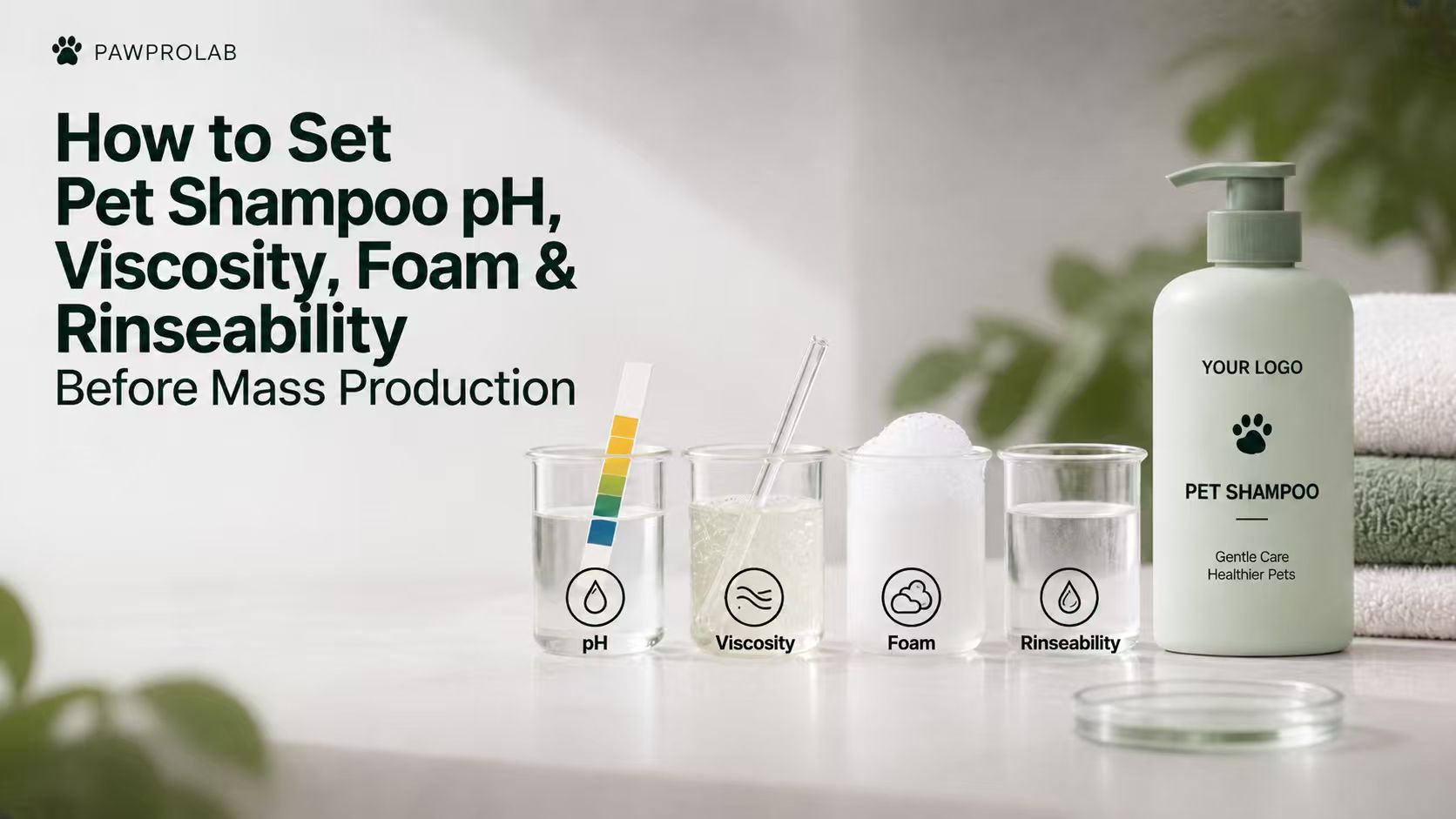
For shampoo projects, our pH, viscosity, foam and rinseability production guide gives a more detailed way to turn formula behavior into an approval record. For wipes, material, liquid base and packaging must be considered together rather than as three independent purchasing decisions. A supplier’s response should identify the linkages that apply to the selected format.
3. Verify the Route, Not a Generic Capability Claim
After a candidate passes the first format gate, verify what work is actually being proposed. The important distinction is not whether a supplier uses the label “OEM,” “ODM” or “private label.” The important distinction is who owns and controls the formula direction, component sourcing, filling route, artwork coordination, sample revision, documentation request and pre-production handoff.
Ask for a clear project map. It can be brief, but it should show the legal company named on the quotation, the proposed manufacturing or filling route, the work handled by outside partners, the approval owners and the conditions that must be met before production can begin. Outsourcing is not automatically a rejection reason. Unclear responsibility is the risk.
| Evidence Request | Useful Supplier Response | Buyer Follow-Up |
|---|---|---|
| Project route | Names the formula, filling, package and artwork steps that apply to the proposed SKU | Record which steps are confirmed, conditional or outside the quoted scope |
| Format experience | Explains relevant constraints without presenting another brand’s confidential information | Ask which sample and package configuration will represent your project |
| Quality and process records | Specifies which record is available, who issues it, what formula/batch/site it covers and when it is available | Do not treat a facility-level document as automatic approval for a finished product |
| External partner involvement | States which party coordinates substrate, component, print, testing or logistics handoffs | Assign one owner for each handoff and escalation point |
| Change handling | Explains what happens if formula, fragrance, component, artwork, quantity or target market changes | Confirm whether the change requires new samples, revised pricing, timing or documentation |
A private label dog shampoo manufacturer that pauses to clarify a closure, claim, artwork status or production-start condition may be providing a stronger project answer than one that agrees to everything immediately. Evidence and named responsibilities are more useful than a generic list of capabilities.
4. Review Formula, Packaging and Samples as One Approval System
The supplier-selection stage should test whether the proposed workflow links formula, component and sample control. A small liquid or gel sample may be useful for direction, but it cannot automatically establish the behavior of a filled bottle, trigger sprayer, foaming pump, wipe substrate, pouch seal, retail label or production batch. Industry private-label shampoo guidance likewise treats a custom formulation sample as a pre-bulk evaluation step, not as proof that every finished-product decision has been completed. [4]
Ask candidates how they identify each sample and each revision. The record should connect the formula version, fragrance direction if any, package version, artwork status, intended market, sample purpose and unresolved decisions. This keeps the buyer from approving one element while assuming that another element has been confirmed.
| Approval Point | What the Buyer Should Record | Decision That Remains Separate |
|---|---|---|
| Formula sample | Version ID, appearance, scent direction if relevant, use observation and feedback date | Whether the selected commercial package and label configuration are also approved |
| Package sample | Component version, closure, dispense route, artwork placeholder/status and observed handling | Whether production material, decoration, packing configuration and shipping route are final |
| Finished sample | Formula/package pairing, approved instructions, target market, reviewer and open deviations | Whether the production batch and final artwork have completed their own required review |
| Pre-production specification | Final formula, component, artwork, agreed quantity, responsibility list and change-control trigger | Any new change introduced after sign-off |
Use the same discipline across forms. When comparing a private label pet foam cleanser manufacturer, the foam route needs its representative pump; when comparing a private label pet wipes manufacturer, the wipe route needs its intended substrate and closure/seal direction. A spray route needs its selected spray component, and a shampoo route needs the relevant package and use instructions. Our formula-sample evaluation guide provides a practical scoring framework for the sample-review portion of this process.
5. Score Only Suppliers That Pass the Critical Gates
Once a candidate has cleared the essential project gates, a scorecard makes trade-offs visible. The scorecard is not a mathematical substitute for judgment. An industry manufacturer-selection framework similarly orders critical gates before later scoring; the buyer still needs to apply that sequence to the exact project scope. [5] A private label dog shampoo manufacturer with a strong total score should still be excluded or paused if it cannot support a project-critical package, cannot identify what its quotation covers, cannot coordinate a required sample route or cannot provide a credible responsibility map.
| Selection Dimension | Evidence to Compare | Question to Record Beside the Score |
|---|---|---|
| Format and route fit | Explanation of the selected shampoo, spray, foam or wipe workflow | Does the response address this format’s actual component and sample dependencies? |
| Formula-package coordination | Proposed package route, review sequence and change conditions | Which compatibility or handling decisions remain open? |
| Sample control | Version identification, feedback method, representative sample plan and revision ownership | What does this sample prove, and what does it not yet prove? |
| Evidence and documentation scope | Record name, issuer, product/site/batch scope, delivery timing and quotation inclusion | Can the buyer connect the record to the specific project without assuming market approval? |
| Commercial clarity | MOQ basis, development charges, package/print terms, exclusions, payment basis and reorder conditions | Which values are confirmed versus estimated or dependent on an open choice? |
| Project communication | Named owner, written assumptions, revision trail, escalation path and decision deadlines | Does the supplier convert ambiguity into a documented next step? |
The purpose of the comparison is to choose project fit, not to find an abstractly “best” factory. The buyer should preserve the evidence behind each score and record open questions beside it. This makes the final selection reviewable when staffing, market, package or quantity assumptions change.
6. Compare Commercial Terms on the Same Scope
Commercial terms become misleading when suppliers are pricing different projects. One quotation may assume a stock bottle and one sample round; another may assume a custom component, multiple revisions, printed packaging and a different quantity basis. The lower price cannot be interpreted until the buyer sees the scope beneath it.
Ask each shortlisted candidate to identify what its MOQ applies to. It may change with formula, fragrance, component, printed material, pack size, artwork, SKU count or reorder conditions. Do not publish or accept a universal MOQ or lead time as though it applies to every private-label project.
| Commercial Topic | Clarification to Request | Reason It Belongs in Selection |
|---|---|---|
| MOQ and quantity basis | What formula, fragrance, component, artwork, size and SKU assumptions sit behind the quantity? | Prevents the brand from comparing unlike quantities or routes |
| Sample and development scope | How many revisions are included, what triggers a new round, and what happens when the brief changes? | Connects the sample plan to timing and cost decisions |
| Package and print scope | Which component, decoration, artwork, packing and storage items are included, buyer-supplied or pending? | Stops a formula quotation from being read as a complete launch cost |
| Production start condition | What must be approved or received before the timeline begins? | Makes timeline statements usable and prevents false certainty |
| Ownership and reorder terms | How are specifications, tooling, buyer artwork, unused packaging and future component continuity handled? | Establishes whether the project can be repeated under controlled conditions |
Packaging decisions often create the most hidden differences in a quotation. For bottle, pouch and gallon trade-offs, refer to our professional pet shampoo packaging guide. It shows why a package route affects product handling, transport, documentation and the buyer’s operating model—not merely shelf appearance.
7. Keep Product Classification and Claims Inside the Brief
Manufacturer selection is also a claim-control exercise. For U.S.-facing projects, FDA’s nonbinding guidance says products intended solely to cleanse or beautify animals may be considered grooming aids, while intended use shown through formulation, labeling and promotional materials can move a product into a drug category. [1] APPA separately notes that flea- or tick-control claims can create pesticide considerations. [2]
That does not mean a sourcing article can decide legal status. It means the buyer should provide the intended market, intended use and draft label/marketing direction before a supplier confirms what it can support. Avoid asking a manufacturer to “make a stronger claim” without defining the claim, its evidence needs and the market review route. A formula direction, fragrance preference or package format does not establish a therapeutic, antimicrobial, parasite-control, allergy-prevention or universal-safety claim.
For consumer packs, labeling discussions can also involve identity, responsible-party and net-quantity questions, with applicable rules varying by market and jurisdiction. [3] For EU destination markets, U.S. FDA and APPA material is not a substitute for qualified local review of the finished product, label language, chemical obligations, claim direction and market-specific responsibilities.
This article is not veterinary, medical, legal, market-authorization, antimicrobial, allergy-prevention, universal-suitability, treatment, parasite-control, certification or guaranteed-performance advice. It is a B2B manufacturer-selection framework for a non-medicated grooming project.
8. Make the Selection Decision Reversible Until the Final Approval Gate
The best early-stage supplier decision is structured rather than irreversible. Select a preferred candidate when it has passed the critical gates, supplied a coherent scope, explained the project route and provided a workable sample and commercial plan. Keep any unconfirmed formula, component, artwork, document, target-market or claim question visible until it is resolved through the appropriate review.
Before a production commitment, capture the agreed formula/package pairing, sample version, artwork status, target market, product directions, quantity basis, quotation scope, owners, start conditions and change-control route in writing. This converts a sourcing conversation into a controlled project handoff.
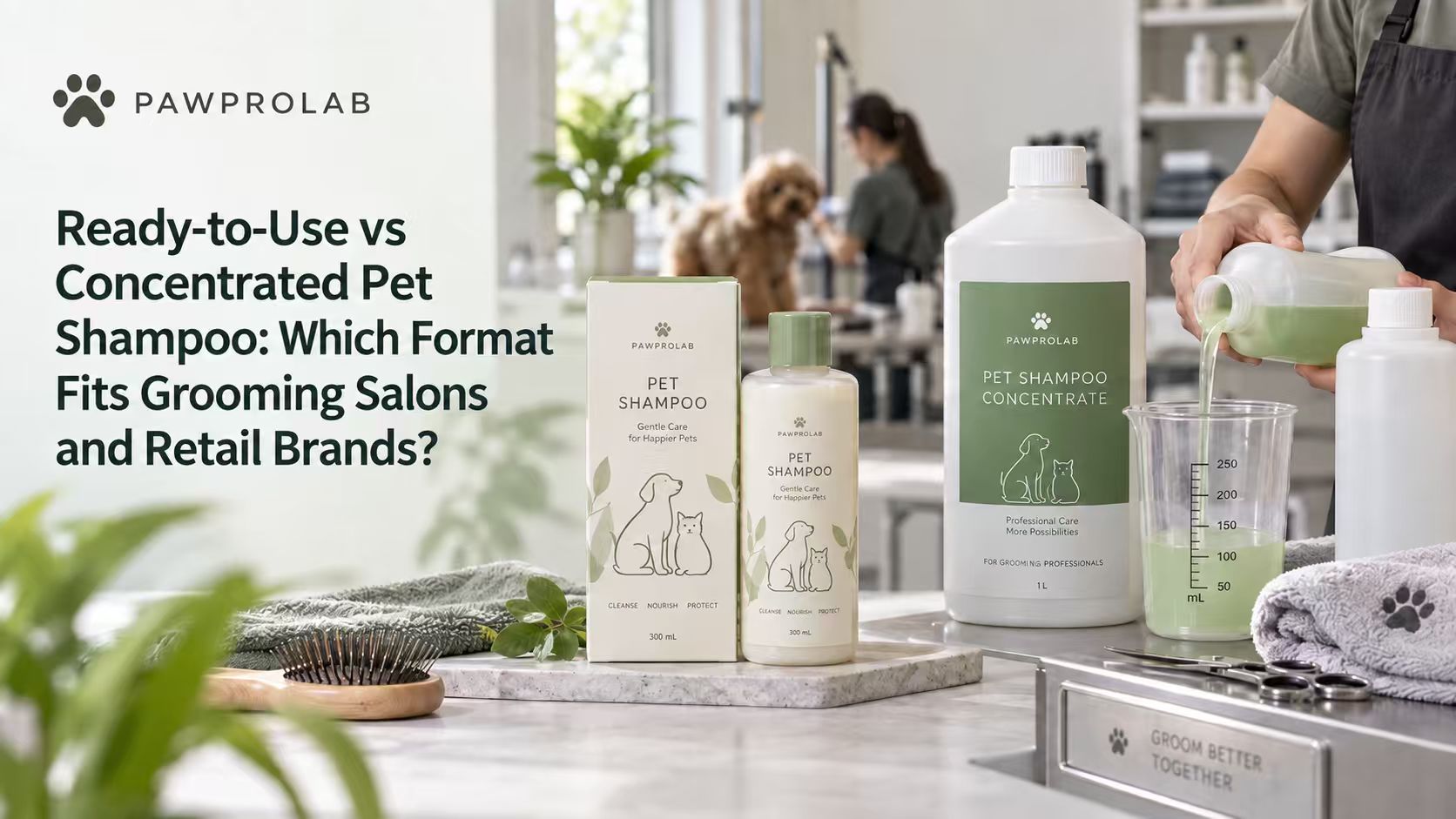
Brands developing a concentrated versus ready-to-use shampoo route should separately confirm the channel and operating implications before finalizing a manufacturer brief. Our ready-to-use versus concentrated shampoo guide helps frame that choice. A waterless project needs its own format review; see our waterless pet bath development guide for the adjacent range-planning questions.
FAQ: Choosing a Private-Label Pet Grooming Manufacturer
Should a brand choose the manufacturer with the lowest MOQ?
Not automatically. First confirm what the quantity applies to: formula, fragrance, component, print, pack size, artwork, SKU or route. A lower stated MOQ can be a poor comparison if the supplier has assumed a different package, sample process or level of customization than the other candidates.
What should a buyer ask a private label dog shampoo manufacturer first?
Give the manufacturer a defined project scope: market, channel, intended grooming use, formula starting point, package direction, estimated quantity, sample expectations, requested support and open decisions. Then ask it to identify the route, assumptions and information needed before a meaningful quotation or sample plan can be prepared.
How is a private label pet spray manufacturer evaluated differently from a shampoo supplier?
A spray project should connect formula direction to the selected spray component, output route, closure, leakage review, residual-feel evaluation, label space and representative pack sample. The buyer should not rely on an unfilled liquid sample as evidence for every part of that system.
What evidence should a buyer request for a foam or wipe project?
For foam, request a clear plan linking formula, foaming pump and representative finished sample. For wipes, request the route linking substrate, liquid load, pouch or canister, seal/closure and sample identification. The correct evidence set depends on the final project scope and target market.
Can a manufacturer approve a product claim for a U.S. or EU launch?
A supplier can explain its project documents and process scope, but manufacturer support is not automatic market approval. Claim and label decisions should be reviewed against the intended product, target market, evidence and applicable qualified local expertise before release.
Request a Grooming Manufacturer Selection Brief
PawLab Pro can help organize a shampoo, spray, foam or wipe project around its target market, product role, format, packaging direction, estimated quantity, sample route and open decisions. A useful first conversation starts with a clear brief, not a generic request for a catalogue. Contact PawLab Pro to request a private-label grooming manufacturer selection brief for your project.
References
- U.S. Food and Drug Administration. CPG Sec. 653.100 Animal Grooming Aids.
- American Pet Products Association. Before Entering the Pet Products Industry.
- American Pet Products Association. Pet Product Labeling Requirements.
- Tropical Products. Private Label Shampoo Manufacturing.
- Rixin Pet Care. How to Choose a Private Label Pet Grooming Manufacturer.