Pet-care OEM insights
How to Build a Professional Pet Salon Shampoo Line Around Dilution Ratio and Coat Type
Plan a professional pet salon shampoo line by coat type, cleaning level, color direction and dilution workflow, with pack and sample checks before scale-up.
TAKEAWAYS
- A professional salon line should give every shampoo a clear operational role—such as routine cleansing, heavier soil removal, coat-texture support or a color-positioning direction—rather than multiplying fragrance variants with the same use case.
- For a concentrated grooming shampoo, the dog shampoo dilution ratio is part of the product system: formula direction, mixing bottle, staff method, prepared-batch rule and label copy must be approved together.
- Plan coat type as a sample-review variable, not as a universal promise. Long, short and dense double coats can help a buyer define the desired spreading, foam, rinsing and finish observations before release.
- Use a core-and-specialist architecture: one repeat-use base route, then only the specialist SKUs that have a distinct salon workflow, approved sample result and commercial reason to exist.
- Keep claims inside routine grooming. A salon shampoo line can be positioned for cleansing, coat appearance and a defined professional process; it should not promise medical, allergy, antimicrobial, color-correction or identical results for every animal.
1. Build a Salon System, Not a Fragrance Assortment
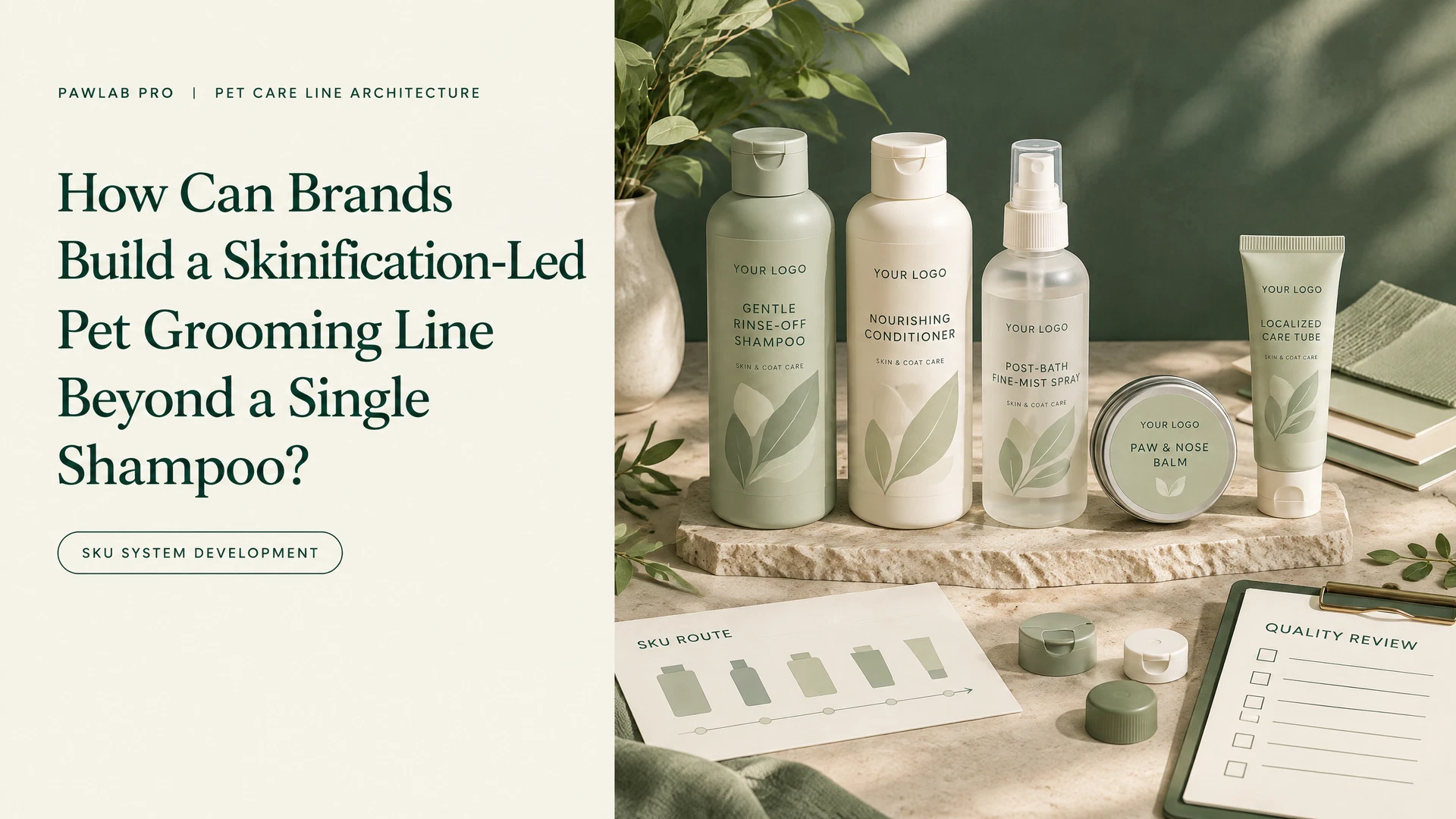
A professional salon buyer rarely needs five interchangeable shampoos with different scents. They need a line that helps the team select, mix, apply, rinse and replenish products consistently across common appointment types. That is the more useful starting point for a professional dog shampoo manufacturer brief: define the salon workflow first, then identify the smallest set of distinct SKU roles needed to serve it.
At the first planning meeting, divide the proposed range by commercial job. A core cleanser may serve routine appointments. A deeper-cleansing or pre-wash route may be relevant when the brand’s approved use concept requires it. A coat-texture or finishing route may need a different feel, rinse profile or system companion. A color-direction SKU, if the brand elects to pursue it, needs its own claim review and use-direction sample. This approach gives the buyer a product map before fragrance, bottle color or marketing names are discussed.
For products intended solely to cleanse or beautify animals, the U.S. Food and Drug Administration describes the category as animal grooming aids. That distinction matters when building a salon assortment: operational grooming language is not a substitute for disease, allergy, treatment or antimicrobial claims. [1]
| Line Role | Commercial Question | Sample Focus | Do Not Assume |
|---|---|---|---|
| Routine salon cleanser | What is the default repeat-use role for the majority of appointments? | Spreading, rinse sequence, scent direction, salon mixing routine and pack handling | One routine SKU will suit every coat, soil level or finishing expectation |
| Higher-cleansing route | Is there a distinct professional workflow that needs a separate cleansing direction? | Approved application, rinse observation and relationship to the base route | “Deep clean” establishes a treatment, odor-control or universal result claim |
| Coat-priority route | Which texture or handling observation makes this SKU commercially distinct? | Use on agreed sample coats, rinse feel and paired conditioner compatibility | A named coat type automatically creates suitability for all breeds |
| Color-positioning route | Is there a clear brand and channel reason for a color-focused SKU? | Directions, label boundaries and the approved visual objective | A color name authorizes transformation or correction claims |
Brands choosing between ready-to-use and concentrated formats should resolve that channel-format decision before finalizing a salon architecture. Our ready-to-use versus concentrated pet shampoo guide explains why format, mixing workflow and retail convenience should not be treated as the same question.
2. Make Dilution Ratio an Operating Specification
For a concentrated salon route, the dog shampoo dilution ratio is not just a number printed on a bottle. It affects the mixing vessel, staff training, prepared volume, backbar storage, per-service cost model and what users experience at the tub. A new brand should approve a product-specific direction only after reviewing the finished formula in the selected concentration and intended mixing workflow.
Published professional product ranges demonstrate why one universal ratio is not credible. Chris Christensen lists full-strength, 4:1 and 50:1 directions for different shampoos in its own portfolio. Those are catalog-specific examples, not a formula target for another brand. They do show that a strong line brief must record a precise formula-to-water instruction rather than call every salon product “concentrated.” [2]
| Dilution Control | Buyer Must Define | What Reviewers Observe | Release Record |
|---|---|---|---|
| Formula-specific direction | Whether the SKU is direct-use or the exact approved mixing instruction | Whether the instruction is understandable and practicable in the selected salon routine | Approved formula code and written direction |
| Measuring method | Mixing bottle, meter, cap, pump or other intended measuring system | Repeatability of the proposed staff workflow | Selected tool and operating note |
| Prepared batch | How much solution is mixed, by whom, and for what defined use period | Whether the amount suits the actual appointment sequence without improvised storage | Preparation and discard/handling direction as applicable |
| Service-cost model | Formula price, approved working dilution, observed use amount and operational inputs | Whether assumptions are separated from verified inputs | Buyer-owned cost worksheet, not a universal savings claim |
Do not use a high dilution number as shorthand for performance, lower cost, less product waste or suitability for every salon. A buyer’s cost-per-service model is valid only when it is built from that buyer’s approved formula, direction, pack, tools, operating practice and commercial inputs.
3. Assign Coat Type to Sample Protocols, Not Broad Promises
Coat type can make a line easier for a groomer to navigate when it is used honestly. Long coats may make spread and rinse time especially visible. Short coats can make skin feel, residue perception and scent level more apparent. Dense double coats can make wet-through, distribution and rinse workflow meaningful review points. These are sample-design considerations, not automatic proof that a product is universally appropriate for every animal in those groups.
A practical range can start with two or three sample lanes: a routine all-coat cleanser, a route evaluated with a dense or high-volume coat scenario, and a finish-focused system that is reviewed with its selected companion conditioner. This is more disciplined than launching many “breed-specific” variants before the brand has data showing a distinct purchase or workflow reason.
| Coat Sample Lane | What to Review | Useful Buyer Question | Boundary for Final Copy |
|---|---|---|---|
| Short or close coat | Distribution control, rinse feel, fragrance level and residue perception | Does the routine feel appropriate for the intended repeat-use position? | Do not turn one observation into a “gentle for all sensitive pets” claim |
| Long or flowing coat | Application path, rinse workflow, tangling observation and system handoff to conditioner | Does the shampoo’s role remain clear before the conditioning step? | Do not promise detangling, repair or identical shine results without substantiation |
| Dense or double coat | Wet-through, spreading, foam distribution and rinse completion under agreed use conditions | Can the selected direction be performed consistently in a salon appointment? | Do not claim faster rinsing or complete soil removal for every animal |
| Texture or finish-priority sample | Desired after-rinse feel and compatibility with the line’s selected finishing step | Does this SKU earn a distinct role beyond fragrance or color? | Do not state a permanent texture change or breed-wide performance promise |
When a separate conditioner is part of the route, the buyer should approve the system rather than isolated claims. Our 2-in-1 versus separate shampoo and conditioner guide outlines why a one-step convenience SKU and a two-step professional system should be validated as different product propositions. For more detail on conditioner positioning, see Pet Conditioner & Detangler OEM.
4. Separate Cleaning Level, Coat Type and Color Direction
Brands often collapse three independent decisions into one product name: how much cleansing the job requires, what coat experience is being prioritized, and whether there is a color-positioning concept. Keeping these decisions separate produces a clearer line architecture and reduces duplicate SKU development. A routine cleanser can be evaluated on its repeat-use role. A dense-coat route can be evaluated on the workflow that makes it distinct. A color-direction concept can be assessed for market positioning and permitted label language without being mistaken for a cleaning or therapeutic claim.
The following mapping is a planning tool, not a mandatory assortment. A young salon brand may launch only a core cleanser and one specialty route. A larger distributor program may need additional formats after the base workflow, sample results and sales plan justify them.
| Planning Axis | Question to Answer | Possible Line Decision | Evidence Needed Before Launch |
|---|---|---|---|
| Cleaning level | Is this a routine cleanser or a clearly different professional cleaning step? | Core cleanser plus a separately positioned cleansing route if justified | Formula direction, sample protocol and non-medical label review |
| Coat-priority experience | Which observed handling or rinse need makes the SKU distinct? | All-coat base, dense-coat sample lane or finishing system lane | Documented review across the agreed test scenarios |
| Color direction | Is a color-oriented concept a genuine channel need rather than a naming variation? | One separately reviewed color-positioning SKU, if the brand brief supports it | Claim review, directions and sample approval for the target market |
| Dilution route | Should the salon use direct product or a defined prepared solution? | Direct-use or SKU-specific concentrate with a controlled mixing process | Formula, bottle/jug, measuring method and label instruction together |
A de-shedding direction should remain distinct from this broader line-planning article. If a buyer wants a seasonal coat-management concept, the work should begin with the narrowly defined grooming positioning in our private-label de-shedding shampoo guide, not a vague claim that a professional salon line stops shedding.
5. Match Bottle, Gallon or Refill Format to the Salon Workflow
Once the SKU roles and dilution directions are known, packaging becomes easier to specify. A retail bottle may fit a direct-use take-home unit. A professional backbar concentrate may need a gallon jug, pump, mixing bottle and visible staff direction. A refill pouch may serve a controlled replenishment system only if the receiving pack, transfer method and traceability are also defined. Packaging should not be selected from appearance alone.
For a salon pet grooming products brief, ask who will carry the pack, who will dose it, where dilution occurs, how the prepared solution is identified and how the team replenishes the system. A private label grooming shampoo program is more credible when the finished formula, closure or dispenser, label, case configuration and operating directions are reviewed as one approval set.
| Format Route | Best Planning Use | Operational Requirement | Approval Check |
|---|---|---|---|
| Retail bottle | Direct-use take-home or consumer-facing specialty SKU | Controlled direct dose and readable product directions | Finished formula, closure, label panel and shipment configuration |
| Gallon or large backbar pack | Professional concentrated route or repeat salon use | Defined carrying, pumping/pouring, measuring and storage practice | Filled-pack handling, selected accessory and dilution sequence |
| Refill system | Controlled replenishment program with a named receiving vessel | Specified transfer, fitment, reseal and traceability process | Formula-pack compatibility and receiving-pack workflow |
For packaging selection and supplier-brief detail, pair this article with Professional Pet Shampoo Packaging: Retail Bottle vs Refill Pouch vs Gallon Jug. It addresses the container-and-channel decision that follows a salon line architecture.
6. Release the Line with a Controlled Sample Scorecard
The most valuable line plan becomes practical only when each SKU can be sampled and released as a defined version. Give reviewers a coded formula, intended package, draft dilution or direct-use direction, selected coat scenarios and a short scorecard. The scorecard should record observations rather than force an unsupported pass claim. That record lets the commercial, product-development and production teams agree on what is approved.
| Approval Field | Record for Each SKU | Why It Matters |
|---|---|---|
| SKU role | Core cleanser, specialist cleansing step, coat-priority route or finish system | Stops overlapping products from reaching the range without a distinct purpose |
| Formula and package | Formula code, fill, bottle/jug/pouch, closure and selected accessory | Connects the approval to the actual version that could move to production |
| Use direction | Direct-use or product-specific dog shampoo dilution ratio and mixing process | Creates a repeatable salon routine rather than a generic concentration claim |
| Coat scenarios | Agreed short, long, dense or finish-priority observations as relevant | Separates observed sample use from an unqualified all-coat promise |
| Decision | Approve, revise, retest or hold, with reviewer and date | Creates a clear handoff into final specification and production authorization |
Use our pet care formula sample evaluation guide when defining the review fields, and our pH, viscosity, foam and rinseability guide when documenting formula-control observations. This article is not a universal dilution, performance, safety, medical, color-change or cost-savings guarantee.
FAQ: Professional Pet Salon Shampoo Line Planning
How many shampoos should a new professional salon line launch with?
Start with the smallest line that has distinct operating roles. A core routine cleanser and one specialty route may be more coherent than several fragrance-led SKUs. Add products only when the target channel, sample protocol, approved directions and commercial purpose are separate and clear.
What is the correct dog shampoo dilution ratio for a professional line?
There is no universal ratio. The correct direction is specific to the finished formula and chosen salon workflow. It should be validated with the selected measuring method, package, application process and label directions before a buyer uses it in a cost or performance model.
Should coat type create separate grooming shampoo SKUs?
Only when a separate SKU has a real product and channel role. Coat scenarios are useful for defining what to observe during sample review, but a broad coat name alone does not establish universal suitability or performance.
Can one salon shampoo line serve both retail and professional grooming?
Possibly, but the retail and salon workflows should be separately specified. Direct-use retail bottles and professional concentrate systems can require different packaging, instructions, measuring tools, pricing logic and approval criteria even if they share a brand family.
Plan the Professional Line Around Repeatable Decisions
PawLab Pro helps B2B buyers turn a salon shampoo concept into an OEM/ODM brief with formula direction, coat-scenario review, dilution workflow, pack selection, sample scoring and production approval. Contact our team to discuss a professional dog shampoo manufacturer program for your salon or professional-grooming channel.
References
- U.S. Food and Drug Administration. CPG Sec. 653.100 Animal Grooming Aids. Updated March 1, 2019.
- Chris Christensen. Mastering Product Dilution with Chris Christensen. Accessed September 12, 2026.