Pet-care OEM insights
White-Coat vs Dark-Coat Dog Shampoo: Which Color-Care Formula Fits Your Brand?
Compare white, light and dark coat dog shampoo positioning, brightening claims, two-SKU choices and sample checks for private label color-care launches.
TAKEAWAYS
- A white coat dog shampoo should be positioned around routine cleansing and a brighter-looking finish on white or light coats—not bleaching, permanent recoloring or stain-treatment promises.
- A dark coat dog shampoo needs a distinct natural-tone, depth or polish brief before it becomes a separate SKU; a dark label alone is not enough product differentiation.
- Brightening dog shampoo can describe an appearance-led grooming route, while “whitening” is a high-risk market term that must be reviewed against the finished formula, evidence and target-market label rules.
- Separate white/light and dark-coat SKUs only when the target user, visual objective, sample protocol, packaging story and commercial role are genuinely different.
- Approve color-care products through controlled formula, package, application and appearance observations—not through an unsupported before-and-after promise.
1. Start With a Color-Care Decision, Not a “Whitening” Claim
For a private-label buyer, the most useful question is not “Can we make a whitening shampoo?” It is whether the brand needs a color-care route that gives customers a clearer grooming choice than a standard cleanser. A well-defined white coat dog shampoo can focus on removing ordinary surface soil and helping white or light coats look freshly groomed after rinsing. A dark-coat route can focus on a polished, richer-looking natural finish. Neither route should imply that the shampoo bleaches hair, changes pigment, reverses discoloration, or delivers the same visible result for every animal.
Color-specific grooming is already a recognizable market category. For example, Bio-Groom presents separate white/light and dark-coat grooming products and describes them through natural coat appearance, brightness, depth and shine. That is evidence of a commercial segmentation pattern, not a formula recipe or a claim license for another brand. [1]
For products intended solely to cleanse or beautify animals, FDA describes the category as animal grooming aids. Brands should keep this article’s product brief, packaging and sales copy within grooming and appearance language unless a different regulated route and substantiation have been established. [2]
| Buyer Question | Useful Product-Brief Answer | Do Not Turn It Into |
|---|---|---|
| What should a white/light route do? | Support gentle cleansing and a cleaner, brighter-looking post-rinse appearance under agreed sample conditions. | A bleaching, pigment-removal or permanent stain-correction claim. |
| What should a dark-coat route do? | Support a polished natural-tone or depth-oriented grooming finish, subject to sample review. | A promise to darken, recolor or repair every coat. |
| When does “whitening” belong in the brief? | As a search term and market-language issue requiring formula, claim and label review. | An unqualified product outcome on the bottle or product page. |
2. Separate Ordinary Cleansing From Optical Brightening
Every shampoo that removes ordinary surface soil can leave a coat looking cleaner. That is not automatically a color-care proposition. The distinct product-development question is whether the formula and permitted communication are meant to support an optical, light-reflective or finish-focused appearance after routine cleansing. This is where a brightening dog shampoo can earn a distinct role without being positioned as a bleaching product.
In a B2B brief, the phrase “optical brightening” should be handled as an appearance hypothesis to test, not a guaranteed effect to print. Reviewers should record what they see under agreed lighting, on agreed coat-color samples and after the approved rinse process. They should also distinguish the observed finish from basic soil removal. This protects the buyer from approving a color-oriented name whose sample experience is indistinguishable from the brand’s standard cleanser.
| Evaluation Layer | What the Team Reviews | Commercial Implication |
|---|---|---|
| Routine cleansing | Spread, lather, ordinary surface-soil removal and rinse completion in the approved use direction. | May support a broad core-shampoo role. |
| Appearance-led finish | Whether white/light coats appear cleaner or brighter-looking, or dark coats appear more polished, in the agreed test setup. | May justify a color-care communication route after claims review. |
| Color transformation claim | Any implication of bleaching, pigment change, recoloring or correction. | Do not approve as a grooming-aid claim without a separate regulatory and substantiation assessment. |
Before a buyer chooses a color-care direction, confirm that the base shampoo is already controlled for pH, viscosity, foam and rinsing in its intended package. Our pet shampoo pH, viscosity, foam and rinseability guide explains why these production-release observations belong in the same approval record as the finish objective.
3. Define White, Light and Dark Coat Positions Without Overlapping the Range
White, light and dark are commercial grouping tools, not chemical proofs. A brand should first define which audiences it is serving: show-oriented groomers, professional salons, breed-specialist retailers, subscription buyers or broad everyday-grooming customers. Only then should it decide whether the color-facing range needs one broad appearance-care SKU, a white/light route, a dark route, or a broader color-family architecture.
A white/light product may begin with an approved brief such as “routine cleansing for white and light coat-care occasions, with a brighter-looking finish under approved sample conditions.” A dark product may begin with “routine grooming for black, charcoal and darker natural coat-care occasions, with a polished natural-tone finish under approved sample conditions.” The words are intentionally narrower than “restores white,” “removes yellow,” “makes black darker” or “repairs faded coats.”
| Potential Lane | Target Buyer Need | Distinct Sample Observation | Copy Boundary |
|---|---|---|---|
| White/light coat care | Customers want a repeat-grooming option for white, cream and pale coat families. | Cleaner-looking and brighter-looking finish under agreed lighting after the approved rinse. | Do not promise bleaching, yellow-stain removal or a universal whitening result. |
| Dark coat care | Customers want a dark-tone grooming option that does not look like the same core cleanser in a different label. | Polished appearance, perceived depth and post-rinse finish on agreed dark-coat sample conditions. | Do not claim recoloring, permanent darkening or breed-wide results. |
| Broad color-care route | A young range wants an appearance-led story without supporting two specialist launch SKUs. | Clear product role and sample result across the selected target family. | Do not present it as a substitute for specialized color transformation. |
PawLab Pro’s Cloud Coat Brightening Pet Shampoo gives buyers an existing product-category entry point. A content strategy should now make the product page and the color-care article reinforce one another: the product page can communicate the approved product proposition, while the article can explain the planning and approval questions behind the choice.
4. Should Your Brand Launch Two Color-Care SKUs?
Two SKUs are justified only if the customer, channel, formula brief, visual objective and commercial story differ in a way a buyer can explain. Launching “white coat” and “dark coat” labels without a distinct sample plan usually creates duplicate inventory, confused marketing and unsupported claims. Conversely, forcing white/light and dark coats into one generic shampoo can leave a brand without a relevant category signal for professional groomers or color-aware retailers.
Use a two-SKU route when the brand has a real reason to develop separate color stories, when representative sample reviews produce meaningfully distinct approved observations, and when packaging and sales materials can keep the products from cannibalizing each other. Use one route when the commercial evidence is thin, the supplier brief is still broad, or the brand cannot articulate an approved difference beyond a bottle color.
| Decision Test | One-SKU Route Is Usually Stronger When | Two-SKU Route Is Usually Stronger When |
|---|---|---|
| Customer and channel | The brand serves broad routine grooming with limited color-specific demand. | Professional, specialty or breed-focused buyers actively seek a white/light and dark-coat choice. |
| Approved product role | One gentle-cleansing and appearance-care role is clear and credible. | Each SKU has a separate target coat-family message and approved sample objective. |
| Operations | Minimums, pack inventory and launch resources favor one controlled version. | Forecasts, labels, pack components and replenishment can support two distinct programs. |
| Claim readiness | Evidence supports only a general grooming appearance statement. | Approved formula, sample record and market review support separate narrow messages. |
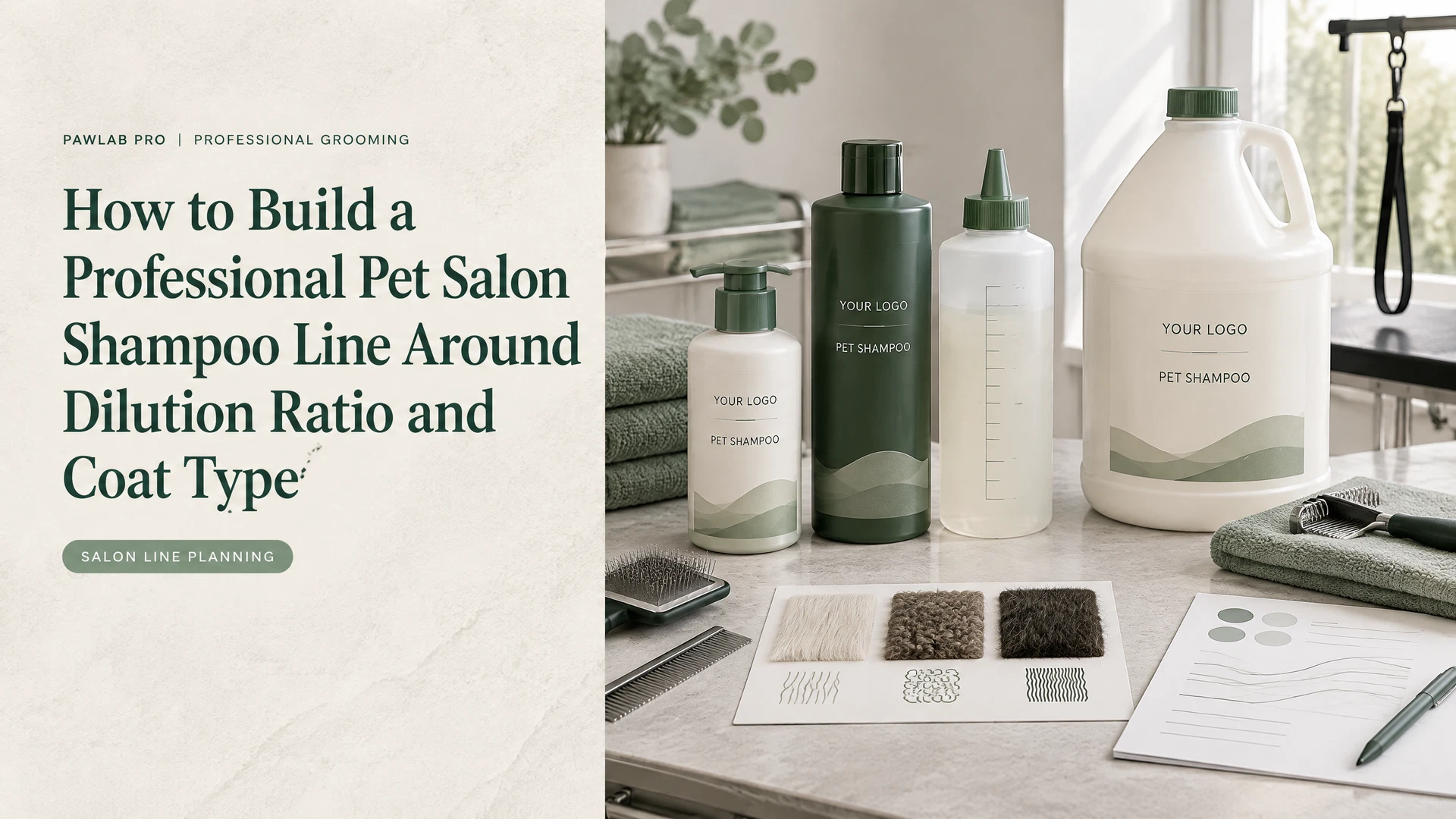
A color enhancing pet shampoo family should be built around this decision evidence rather than a claim hierarchy. For a broader professional assortment, see our professional pet salon shampoo line guide. It helps brands separate coat experience, cleansing role, color direction and dilution route before adding SKUs.
5. Treat “Whitening” as a Search-Term and Claims-Review Problem
Buyers often search for private label whitening dog shampoo, so the phrase belongs in a considered SEO and procurement conversation. It should not force a manufacturer to place a bleaching implication in the final claim set. The safer manufacturing task is to ask what the buyer means: a white-coat appearance route, a cleaner-looking finish, ordinary surface-soil removal, an optical presentation effect, or a controlled professional-grooming application.
Then translate that request into a product-development brief. Record the desired target audience, the intended appearance language, the formula version, the package, the application direction, the sample scenario and the final claim reviewer. If the buyer cannot distinguish “brightening” from “whitening” in the target market, that ambiguity should be resolved before artwork approval—not hidden in a late-stage label revision.
| Buyer Phrase | Product-Development Translation | Required Review |
|---|---|---|
| “White coat shampoo” | Define white/light target coats, ordinary cleansing expectation and an approved visible-finish observation. | Formula, application, packaging and target-market claim review. |
| “Brightening dog shampoo” | Define a limited appearance-led proposition and whether it is needed beyond a core cleanser. | Sample documentation under agreed conditions and precise label language. |
| “Whitening shampoo” | Clarify the intended market-search meaning before accepting any final copy. | Claims and regulatory review before formula lock or artwork release. |
6. Approve a Color-Care Formula as a Controlled System
A color-care launch is approved as a system, not a fragrance idea. The system includes formula code, selected pack, closure, intended direct-use or dilution direction, target coat family, agreed observation method and final market copy. A strong sample review does not need to pretend that every dog will look identical; it should document what was observed under controlled conditions and whether the label says no more than the evidence can support.
| Approval Field | What to Record | Why It Prevents Overlap |
|---|---|---|
| SKU role | Core cleanser, white/light appearance route, dark-coat appearance route or broad color-care route. | Ensures every item has a job beyond fragrance or bottle color. |
| Target sample lane | Defined white/light or dark natural-coat scenarios, lighting and reviewer protocol. | Separates a targeted observation from a universal outcome claim. |
| Formula and use direction | Formula code, fill format, rinse workflow and any product-specific usage direction. | Connects the approved observation to the actual production version. |
| Final copy | Approved appearance-language claims and prohibited wording for the target market. | Stops brightening language from becoming an unsupported whitening or treatment promise. |
Use our pet care formula sample evaluation guide to define reviewers, criteria and approval status. If seasonal coat-management positioning is also under consideration, keep it separate from color-care development by using the narrower private-label de-shedding shampoo guide.
FAQ: White-Coat and Dark-Coat Dog Shampoo Development
Is white coat dog shampoo the same as bleach?
No. A responsible white/light coat-care brief should focus on routine grooming, ordinary cleansing and a limited appearance objective supported by sample review. It should not describe bleaching, pigment removal or permanent coat-color change.
What is the difference between brightening dog shampoo and a standard cleanser?
A standard cleanser may remove ordinary surface soil. A brightening route requires a separately defined appearance objective, controlled sample observation and reviewed wording. It should not be assumed from a fragrance, tint or product name alone.
Do brands need a separate dark coat dog shampoo?
Only if it has a distinct commercial and product role. The target customer, sample protocol, appearance objective, formula brief, packaging story and final claim language should demonstrate why it is not merely a duplicate of the core cleanser.
Can a private-label whitening dog shampoo claim to remove stains?
Not by default. “Whitening” is a buyer search term that needs to be translated into narrowly reviewed grooming language. Claims about stain removal, bleaching, treatment or color correction need separate technical, legal and market review before any final communication is approved.
Build a Color-Care Line That Buyers Can Understand
PawLab Pro helps brands turn a color-care concept into a controlled OEM/ODM brief: product role, coat-family focus, formula and package direction, sample protocol, claims review and production release. Contact our team to discuss a white coat dog shampoo, dark-coat route or broader color-care program with a clear commercial role.
This article is not a bleaching, recoloring, permanent stain-removal, medical, universal suitability or guaranteed visual-performance claim.
References
- Bio-Groom. Color-Enhancing Pet Shampoos. Accessed September 16, 2026.
- U.S. Food and Drug Administration. CPG Sec. 653.100 Animal Grooming Aids. Updated March 1, 2019.