Pet-care OEM insights
Professional Volumizing Pet Shampoo: How to Write a Lift-and-Finish Sample Brief Without Performance Guarantees
Write a volumizing pet shampoo sample brief around lift, finish, rinse, fragrance, pump output and professional packaging without performance guarantees.
A professional volumizing pet shampoo sample brief should tell the buyer and development team how to observe lift-and-finish, wash-after handfeel, rinse experience, fragrance, dispensing and professional-channel packaging in one controlled sample review. It should not promise that every coat type will look fuller, that a result will last for a specified period, or that a salon will obtain the same outcome in every workflow. The useful deliverable is a written approval record: what the selected sample is, which conditions were used, what the reviewers observed, which wording is still proposed, and what must be reconsidered before a release decision.
This B2B article is for OEM/ODM buyers, Private Label brands, distributors, retailers and professional-grooming teams developing a volume-oriented rinse-off shampoo lane. It does not prescribe a formula, ingredient, fragrance, dilution direction, pump output, fill size, coat suitability, product claim, test, certificate, MOQ, lead time or production result. Instead, it creates a Lift-and-Finish Sample Brief around the buyer’s own target market, selected coat-profile samples, package route, reviewer group and evidence questions.
TAKEAWAYS
- Make a professional volumizing pet shampoo brief a controlled sample document, not a promise that every coat will reach a named amount of volume or a salon result.
- Write “lift,” “finish,” “wash-after handfeel” and “rinse experience” as reviewer observations with stated test conditions, not as unqualified consumer-facing claims.
- Approve the formula/version, selected coat-profile scope, wash conditions, fragrance direction, package/closure, pump output and artwork status together whenever possible.
- Use an open-issue rule. A formula, fragrance, pump, bottle, dilution direction, target market, proposed wording or coat-profile change may require a new review; it is not automatically the same sample decision.
- Keep claim language separate from sample preference. If a brand proposes objective lift, duration, all-coat or professional-outcome wording, it needs an appropriate claim-review and support question before release.
1. Start With One Lift-and-Finish Sample Brief, Not a Volume Promise
A volumizing dog shampoo OEM project becomes hard to approve when the brief says only “more volume.” That phrase does not identify the intended channel, the selected coat-profile scope, the wash context, the comparison point, the observed finish, the package used, the wording under review or the person who can release the next step. It also encourages a claim discussion before the brand has defined what it actually wants reviewers to see and record.
The first project output should be a buyer-owned Lift-and-Finish Sample Brief. It joins six inputs that are normally discussed separately: product role, sample identification, review conditions, observed sensory and grooming criteria, component/dispensing configuration, and claim/artwork status. PawLab Pro’s Professional Volumizing Pet Shampoo is positioned as a configurable rinse-off platform for volume-oriented professional-grooming concepts. The product page makes clear that final formula, fragrance policy, pack route, claims and market documentation are subject to sample approval. This article explains how a brand can organize that approval; it is not a product-performance promise.
| Brief Field | What the Buyer Should State | What It Does Not Establish |
|---|---|---|
| Product role | Volume-oriented rinse-off shampoo role, intended professional/retail channel and how it differs from a cleanser, conditioner or 2-in-1 route | A universal result, product recommendation or final market claim |
| Selected coat-profile scope | The buyer’s chosen profiles or material model, the reason for selection and any profiles outside the review | Performance on every breed, coat condition or grooming situation |
| Lift-and-finish review language | The words reviewers will use for observed body, separation, finish, handfeel and post-rinse manageability | A measured volume amount, duration or guaranteed salon outcome |
| Wash conditions | Sample/version, dilution direction where relevant, water/handling context, rinse sequence and any paired products | A fixed protocol for all brands, coat types or markets |
| Pack and dispensing route | Bottle/closure or backbar configuration, intended pump/dispensing direction, fill status and artwork state | Compatibility, leak resistance, output accuracy or channel readiness without review |
| Claim/artwork status | Every proposed consumer phrase, market/language, draft directions, evidence question and named review owner | Claim approval, market clearance or regulatory determination |
This is intentionally more specific than our guide to evaluating pet-care formula samples before production. That guide addresses general formula-sample work. The Lift-and-Finish Sample Brief adds the unique volume-oriented question: what exactly does the brand mean by lift and finish, under which recorded conditions, for which selected scope, and in which finished configuration?
2. Translate “Lift and Finish” Into Observable Review Criteria
A private label volumizing dog shampoo should not use “lift” as a shortcut for a promised result. Use it as reviewer vocabulary. The brief should describe what a reviewer will observe after the agreed wash and rinse sequence, what comparison is relevant to the project, and which items are outside scope. This lets a brand document a preference without pretending that a subjective grooming outcome has become a universal claim.
| Review Area | Sample-Brief Question | Record at the Review |
|---|---|---|
| Body/lift impression | What visual or handling characteristic should reviewers note after the agreed wash and finishing sequence? | Reviewer language, comparison context, whether the observation met, partly met or did not meet the buyer’s stated preference |
| Finish | What should the finished coat feel or look like to the defined reviewer group, and what should be avoided? | Observed finish descriptors and the unresolved change request, if any |
| Wash-after handfeel | Which handfeel cues matter after rinse and during the agreed drying/finishing step? | Named observer, context and the terms used; not an all-coat conclusion |
| Foam and distribution | Is foam behavior being reviewed as part of application workflow, and is the use condition recorded? | Sample/version, directions followed and practical observations |
| Rinse experience | What does the buyer expect reviewers to note about rinse sequence, time impression and post-rinse feel? | Contextual reviewer observation, not an “easy rinse” promise for every use case |
The article does not replace the mass-production controls in setting pH, viscosity, foam and rinseability before mass production. Those are formula-control questions. A volume-oriented brief uses that technical work as an input and adds the commercial review record: which selected sample was evaluated, how the buyer described the finishing preference, what was actually observed, and whether the package/wording remained aligned with the decision.
3. Record the Wash, Rinse and Finish Conditions Before Comparing Samples
A sample decision is weak when two reviewers describe different experiences but no one recorded the context. A pet shampoo sample brief should state the buyer-selected review setup before reviewers start describing lift or finish. This is not an instruction to perform a universal grooming protocol. It is a way to make one project’s comparison intelligible.
| Condition to Record | Project-Specific Information | Why It Belongs in the Brief |
|---|---|---|
| Sample identity | Formula/version, sample date, current status and whether the fragrance direction is part of this sample | Prevents comments from being assigned to an unspecified formula or later revision |
| Selected review scope | Buyer-selected coat-profile or material-model scope, exclusions and review owner | Prevents a limited review becoming an all-coat promise |
| Use direction | Current draft direction, dilution direction where relevant, amount/dispensing instruction and any paired shampoo/conditioner decision | Shows what reviewers actually followed without setting a universal consumer instruction |
| Wash and rinse sequence | Recorded sequence, water/handling context, review stage and whether the sample was assessed alone or in a system | Distinguishes an observed workflow from an unqualified product claim |
| Finish observation point | When reviewers observed the requested finish, which tools/processes were part of the buyer’s selected review, and who recorded the observation | Connects the sample opinion to a defined review event |
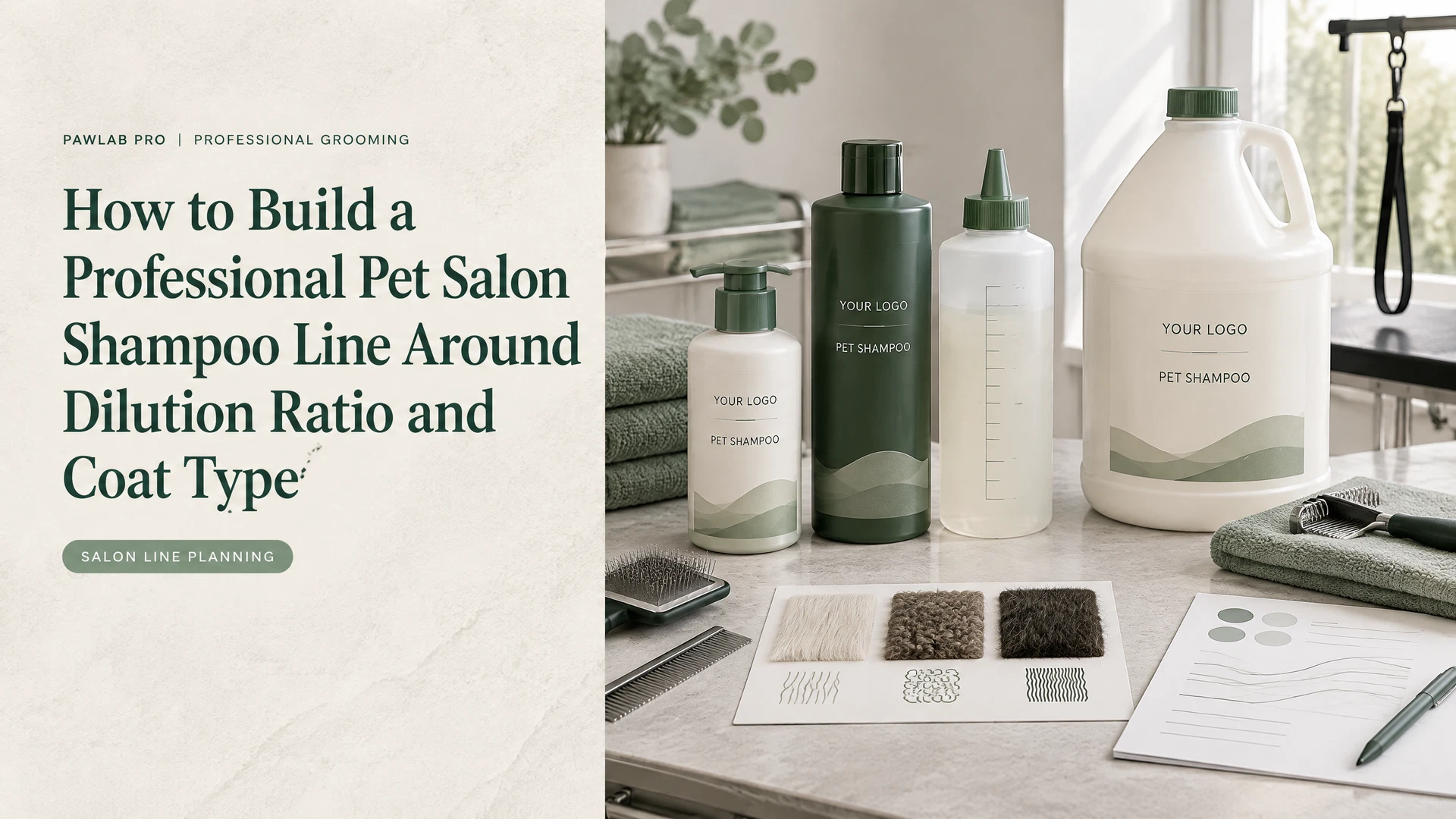
For brands planning a multi-SKU professional route, connect this record to the line architecture in building a professional pet salon shampoo line around dilution ratio and coat type. That page helps frame product roles and selected coat-type routes. The current brief is narrower: it records how the brand evaluated one volume-oriented shampoo configuration and how its review should be interpreted.
4. Treat Fragrance, Pump Output and Pack Route as Sample Inputs
Fragrance, a pump or closure, and a professional-channel pack are not finishing touches. They can change how a reviewer receives the sample and how the project is presented. The buyer should identify whether each is selected, provisional or out of scope. The sample decision should show the configuration used instead of treating a formula beaker, an empty bottle and an artwork draft as one completed product.
Commercial packaging sources describe different dispensing routes and the role of components in handling workflows, but they do not prove that any chosen route will work for every formula, fill, channel or shipment. [3] For this reason, the brief asks the buyer to review the selected configuration rather than copying an output number or a component claim into the final product specification.
| Configuration Input | What to Write in the Brief | Representative-Sample Question |
|---|---|---|
| Fragrance direction | Current fragrance/no-fragrance position, intensity preference, target channel and whether it is final or exploratory | Was the fragrance direction actually present in the formula sample reviewed, and is it tied to the current wording? |
| Pump output or dispensing route | Chosen pump, cap or backbar dispensing direction; component status; current target use workflow; questions still open | Was the formula paired with the selected component, and what did the reviewer observe in the agreed handling context? |
| Bottle, closure and fill | Selected/placeholder component, intended fill basis, closure/fitment, label/print state and channel path | Which parts are representative, which are mockups and which need a later component review? |
| Professional-channel route | Retail, e-commerce, salon backbar, distributor or mixed route; whether dilution/dispense directions are included | Does the sample decision match the named channel workflow, or is a separate configuration needed? |
| Artwork and directions | Draft product name, directions, proposed volume/finish descriptors, languages and market-review owner | Are reviewers approving the actual draft they saw, or only a formula/pack idea? |
This distinction is important for professional grooming shampoo packaging. Read our retail bottle, refill pouch and gallon-jug guide for channel comparison and our pet shampoo refill-system record for source-to-use and traceability questions. Neither article decides the right component for this volume-oriented product. The Lift-and-Finish Sample Brief tells the project team which component route was paired with the selected sample and what still requires review.
5. Separate Sample Preference From Product-Performance Language
A well-liked sample does not automatically support an objective claim. The U.S. FTC’s Advertising Substantiation Policy Statement explains that advertisers should have a reasonable basis for objective advertising claims before dissemination. [2] That is a general advertising principle, not an approval of this shampoo, a prescribed test or a conclusion for a particular destination market.
The practical implication is simple. Keep a reviewer’s project preference in the sample record, then ask a separate claim question for every proposed consumer-facing statement. “Reviewers preferred the finish under this recorded sample setup” is a project observation. “Creates lasting volume for all coats” is a broader objective message that cannot be silently inferred from the sample discussion.
| Project Statement | How to Treat It in the Brief | What It Must Not Become Automatically |
|---|---|---|
| “The buyer prefers more body after the agreed finish sequence.” | Record as a sample-review preference with conditions, reviewer and next action | A duration, amount-of-volume or all-coat marketing claim |
| “The rinse experience was preferred in this review.” | Record the sample/version, directions and observation point | An unqualified easy-rinse or water-saving promise |
| “The fragrance direction fits the intended premium salon lane.” | Record as brand/series positioning subject to formula and wording review | A universal sensitivity, safety or consumer-preference claim |
| “The selected pump route worked in the reviewed configuration.” | Record component status, formula/version and remaining packaging questions | A compatibility, output-accuracy, leak-proof or logistics guarantee |
| “The product is a rinse-off grooming aid concept.” | Keep its intended use, label direction and target market visible for review | A therapeutic, veterinary, antimicrobial, allergy-prevention or medical position |
FDA’s nonbinding Compliance Policy Guide addresses products intended solely to cleanse or beautify animals, commonly described as grooming aids. [1] It does not provide a universal allowed-claim list, approve a finished shampoo or replace a qualified review of the actual product, intended use, artwork and target market. This article is not veterinary, medical, therapeutic, legal, market-authorization, antimicrobial, certification, universal-safety or guaranteed-performance advice.
6. Release a Configuration, Then Reopen It When a Controlled Input Changes
Before a quote or repeat order is treated as the same project, the buyer should decide what changes reopen review. That rule protects both the sample record and the claim/artwork workstream. It also prevents a formula sample from being treated as approval of a later fragrance, pump, pack, direction or market variant.
| Change State | Examples | Buyer-Side Action |
|---|---|---|
| No controlled change | Same recorded formula/version, selected coat-profile scope, use-direction context, fragrance position, component route, artwork/directions, target market and review owner | Use the approved brief as the current decision record, subject to applicable production and commercial confirmation |
| Document review | Clarified owner, date, record format or non-substantive commercial detail that does not alter formula, component, wording, market, sample scope or direction | Update the brief and confirm that no controlled review input changed |
| Representative-sample review | Formula, fragrance, selected coat-profile scope, dilution/dispensing direction, pump/cap, bottle, fill, closure or artwork change that affects what is reviewed | Request a defined representative-sample review before relying on the previous lift-and-finish decision |
| Market/claim review | New destination country, language, sales channel, intended-use wording, professional-result descriptor, duration statement or consumer-facing claim | Route the actual finished configuration through the applicable qualified claim, label and market review |
Brands deciding whether to make a combined shampoo-and-conditioner SKU or a separate system should also read 2-in-1 versus separate shampoo and conditioner. That decision affects the product role and the sample review. It does not make lift, finish, rinse experience or pump behavior automatic outcomes.
FAQ: Volumizing Pet Shampoo Sample Briefs
What should a professional volumizing pet shampoo sample brief include?
Include the product role, target market and channel, selected coat-profile review scope, formula/version, wash/rinse/finish context, reviewer language for lift and finish, wash-after handfeel criteria, fragrance position, package and dispensing route, artwork/directions status, proposed wording, reviewer, open items and release/change rule. This creates a decision record rather than an unqualified volume promise.
Can a volumizing dog shampoo OEM guarantee volume on every coat type?
No. A sample review can capture the buyer’s observations under a defined project setup. It should not become a promise about all coat types, all grooming processes, a specific degree of volume, a duration, a salon outcome or a universal suitability claim. If the brand proposes an objective public claim, it needs a separate support and claim-review question.
How should a private label volumizing dog shampoo handle fragrance?
State whether the fragrance direction is selected, provisional or excluded from the current sample. Record the intended channel, current wording and the sample/version reviewed. A fragrance preference in a sample conversation does not prove a universal consumer preference, sensitivity outcome or final market wording.
Why does pump output belong in a pet shampoo sample brief?
Pump or dispensing route can affect the configuration that reviewers handle. State the selected or provisional component, target workflow, bottle/closure status and questions still open. Review the named formula and component together where possible rather than assuming a general compatibility or output promise.
Does the Lift-and-Finish Sample Brief replace a production specification?
No. It captures the buyer’s sample-review decision and open questions. Final formula, component, artwork, directions, intended market, claim language, production specification and commercial conditions require their own appropriate approvals.
Request a Volumizing Shampoo Sample-Review Plan
PawLab Pro can help a brand frame a volume-oriented rinse-off shampoo project around the intended market, sales channel, selected coat-profile scope, current formula/sample status, lift-and-finish review language, fragrance direction, package and dispensing route, artwork status and estimated first-order scope. Contact PawLab Pro with those inputs to request a representative-sample and quotation discussion for a Professional Volumizing Pet Shampoo project.
References
- U.S. Food and Drug Administration. CPG Sec. 653.100 Animal Grooming Aids.
- Federal Trade Commission. FTC Policy Statement Regarding Advertising Substantiation.
- McKernan Packaging Clearing House. Pet Shampoo Packaging: Functional Designs That Pet Parents Love.